The abstract :
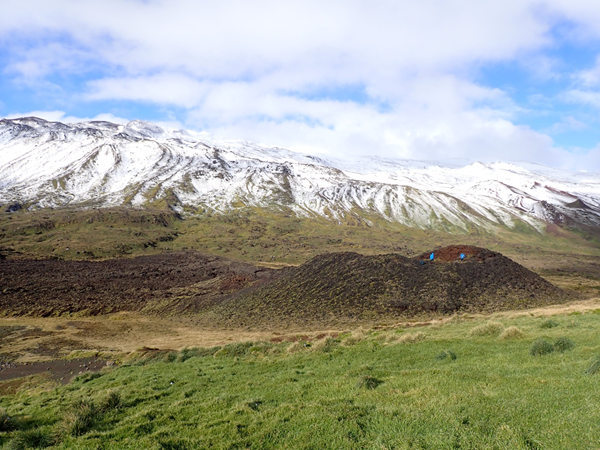
For paleoclimate studies of the Southern Hemisphere, sub-Antarctic Islands act as important sentinels to assess the nature and timing of Quaternary glaciations. As such, the character and extent of past glaciations on sub-Antarctic Marion Island (46°S; 37°E) have remained an important research focus over the last two decades. In this talk I will provide an overview of the approaches used to reconstruct the island’s past glaciations starting with a (re-)assessment of geological history and geomorphological evolution and then the application of relative and direct age-dating techniques, such as rock weathering and cosmogenic 36Cl exposure dating. I will highlight some challenges and opportunities imposed by gaps in our knowledge of the island’s landscape evolution in applying these techniques, and present our approach to circumvent these.
This provided the baseline for our new study, which is to apply formation age dating, K-Ar here at GEOPS to 1) refine the island’s Holocene volcanic history, and 2) to calibrate cosmogenic 36Cl production by Ca spallation. The island’s oceanic basalts provide a unique opportunity to attempt a Southern Hemisphere calibration for cosmogenic 36Cl from Ca spallation We apply electric pulse selective fragmentation (selFrag) technology for mineral separation (as opposed to mechanical crushing), which allows us to extract higher quality and quantity minerals from field samples. I will present our initial experiences with adding this technique to our procedures.