
Geological and geothermal modeling and simulation
GEOPS is equipped with several software programs for thermal and dynamic modeling and simulation of flows.
Our teams use Petrel© and Dionisos© 3D geological modeling software, Techlog© and EasyTrace© drilling data management and processing software, Eclipse© and PumaFlow© thermo-hydro-dynamic simulation software for porous media, and the Tough3© code.
We are also equipped with Pix4D© software for building photogrammetric models of 3D outcrops and Virtual Reality Geological Studio (VRGS©) software. For photogrammetry, georeferenced photographic acquisitions are carried out using a Mavic2pro drone equipped with a high-resolution camera (>12 Mpix). We have a room dedicated to 3D geological modeling with 18 computers that our Master’s and PhD students can use to learn how to use this software. This equipment allows us, for example, to “transpose” outcrops from natural environments into the laboratory, locating the samples taken, replacing the sedimentary logs, mapping the facies or correlating them, and finally modeling and simulating flows in reservoir analogues (reservoir analogue catalog).
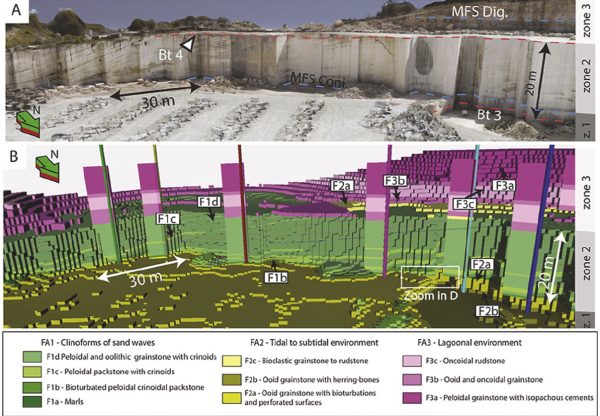
Image: Photogrammetric model of the Massangis quarry and 3D modeling of facies using a geomodeler Thomas et al., 2021 https://doi.org/10.1016/j.marpetgeo.2020.104772 and https://skfb.ly/6RYGF
Paris-Saclay University and our laboratory benefit from several license donation programs with Schlumberger (Petrel, Dynel, and Techlog) and BeicipFranlab (PumaFlow, Dionisos, and EasyTrace).
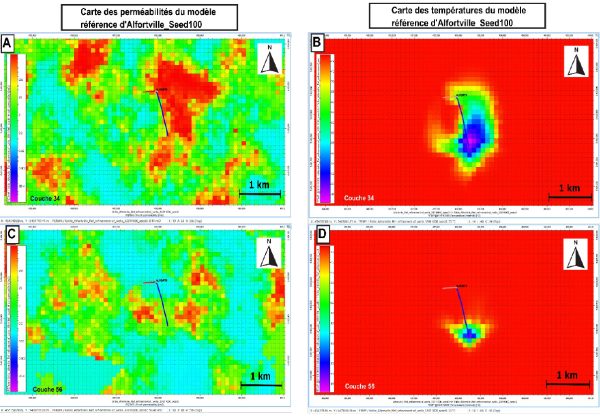
Image: Results of modeling the advance of the cold bubble in a geothermal doublet. Shown are the permeability distribution in the geological model at two different depths (A) and (C) and the temperature distribution after 30 years of operation of the geothermal facility (B) and (D). The extraction well is located at the north end of the black line, and the reinjection well is located south of the black line. The red areas indicate high permeability and high temperature, respectively, while the blue and purple areas indicate low permeability and low temperatures. It can be seen that in the upper layer (A and B), the cold bubble has reached the extraction well, following a non-linear trajectory via a channel with good permeability. In contrast, in the lower layer (C and D), the cold bubble is blocked by an area of low permeability.
MOVE suite Software
Keywords:
2D and 3D geological modeling, kinematic modeling, restoration, deformation mapping, fracture modeling.
Main applications:
Move is geological modeling software that provides a comprehensive digital environment for structural modeling to reduce risks and uncertainties in geological models. It is a platform for integrating and interpreting data, constructing cross-sections, creating 3D models, restoring and validating kinematics, modeling geomechanics, modeling fractures, modeling faults, and analyzing faults and stresses.
Specifications:
Move is a software package that runs on Windows (64-bit).
The GEOPS laboratory recognizes free access to the educational license for the MOVE software suite granted by Petroleum Experts Limited, equivalent to £1,928,384.01, as contractually agreed.

Links:
INSU News: Contribution of drone photogrammetry to 3D modeling of carbonate reservoir heterogeneities
Reservoir analog catalog: http://hebergement.universite-paris-saclay.fr/upgeo/?page_id=430