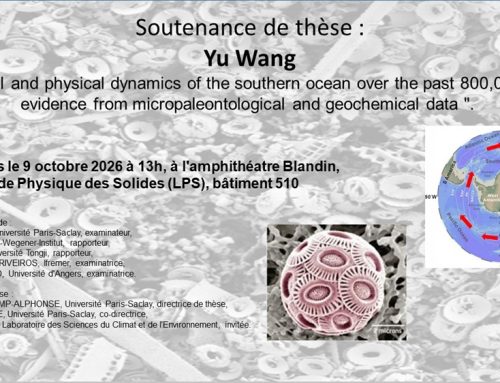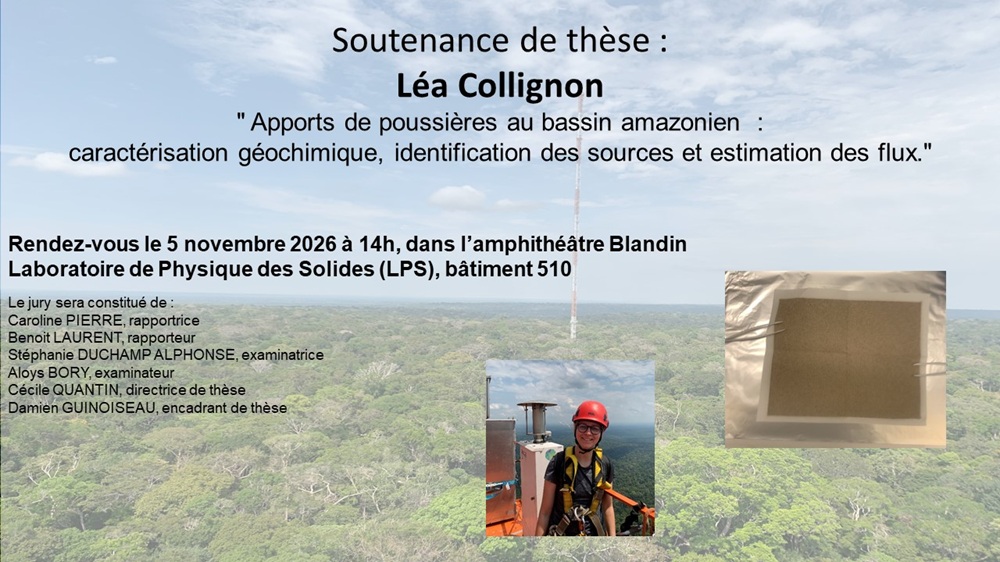
Title : Dust inputs to the Amazon Basin: geochemical characterization, source identification and flux estimation
Abstract : Desert mineral dust constitutes one of the major natural sources of atmospheric aerosols and plays an important role in the climate system and biogeochemical cycles. North Africa, particularly the Sahara and Sahel regions, is the world’s largest source of mineral dust. A substantial fraction of these particles is transported over several thousand kilometers across the Atlantic Ocean to South America, where their deposition contributes to nutrient inputs to Amazonian soils. However, changes in dust flux, composition, and the availability of associated elements during long-range transport remain poorly documented.
This thesis aims to quantitatively and chemically characterize the evolution of North African dust during its transport to the Amazon Basin, identify its sources, and assess the potential nutrient inputs and associated fluxes during dust events, while accounting for other particles transported concurrently, including sea spray aerosols, biomass-burning particles, and anthropogenic aerosols. To achieve these objectives, an approach combining in situ observations, elemental, isotopic, and mineralogical characterization, satellite observations, atmospheric reanalyses, and transport models was developed.
The first part of this thesis focuses on the development and validation of a sequential selective extraction protocol designed to distinguish different aerosol fractions according to their geochemical behavior: the water-soluble fraction, the acid-soluble fraction, and the residual fraction associated with the silicate matrix. This protocol allows the contribution of these different phases to the total elemental composition to be determined and the silicate fraction to be isolated for Sr-Nd-Pb isotopic analysis, thereby enabling the provenance of mineral dust to be determined.
The second part focuses on the chemical and isotopic characterization of a major dust event observed in French Guiana in January–February 2024. Changes in elemental composition, element availability, and particle provenance were investigated throughout a single dust event. This study demonstrates that North African dust contributes nutrients to the Amazon Basin and that their availability is enhanced by the chemical transformations occurring during transatlantic transport. It also reveals a predominantly West African origin and an overall homogeneous composition throughout the event.
Finally, the third part examines dust evolution between the northeastern coast of South America and the central Amazon. Detailed characterization of the dust allows changes occurring during its transport into the continental interior to be investigated and its potential contribution to atmospheric nutrient inputs to the Amazon rainforest to be quantified. The results show broadly similar chemical composition and behavior at the two sites, while the estimated dust deposition flux indicates a substantial decrease in dust inputs toward the interior of the Amazon Basin.
Overall, this thesis provides new constraints on the composition, provenance, evolution, and elemental availability of North African dust transported to the Amazon Basin. It also provides estimates of dust fluxes associated with the investigated events, contributing to a better quantification of atmospheric inputs to the Amazon.
s, permettant de mieux quantifier les apports atmosphériques vers l’Amazonie.