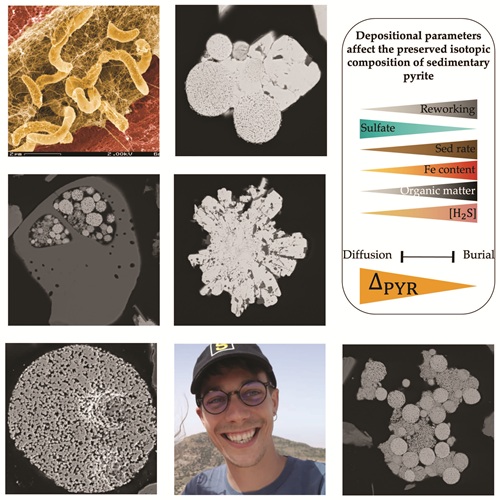
Nous aurons le plaisir d’accueillir Virgile Pasquier (Lausanne) le jeudi 29 janvier à 13h au 2ème étage du bâtiment 504 pour un séminaire intitulé : ” Sedimentary and oceanographic controls on the S-isotopic composition of pyrite in modern marine sediment (and sedimentary rocks)”.
Abstract :
Understanding why the sulfur isotopic composition of sedimentary pyrite (δ34Spyr) varies is central to reconstructing Earth’s surface oxidation through time. Traditionally, stratigraphic shifts in δ34Spyr have been interpreted as reflections of global changes in the sulfur cycle. However, the influence of local depositional conditions and regional oceanographic processes has long been underestimated.
In this presentation, I will present δ34Spyr records from glacial–interglacial sequences recovered across a range of continental margins and deep basinal settings. These intervals are ideal ‘study-cases’ because we know that the global sulfur cycle – and particularly marine sulfate – was remarkably stable. Despite this stability, the cores show strikingly different δ34Spyr evolutions, not only in their absolute values but also in the direction and magnitude of isotopic change through time. These contrasting patterns reveal that δ34Spyr in shelf sediments is primarily shaped by local depositional environments, whereas longer-term variations in ocean circulation dominate the signal in basinal settings. Together, these findings call for a reevaluation of the widespread assumption that δ34Spyr stratigraphy directly tracks global environmental change
I will also show how microscale sulfur isotope measurements – unlike bulk-rock analyses – provide a powerful way to separate primary environmental (and microbial signals) from diagenetic overprints. When coupled with bulk geochemical data, this multi-scale approach not only refines our understanding of when and where pyrite forms, but also opens new opportunities to reconstruct past sea-level changes and benthic methane fluxes. Ultimately, these methods allow us to better distinguish the feedback between climate and biogeochemical signals from diagenetic artifacts, improving how we use the sedimentary sulfur record to better read Earth’s past.