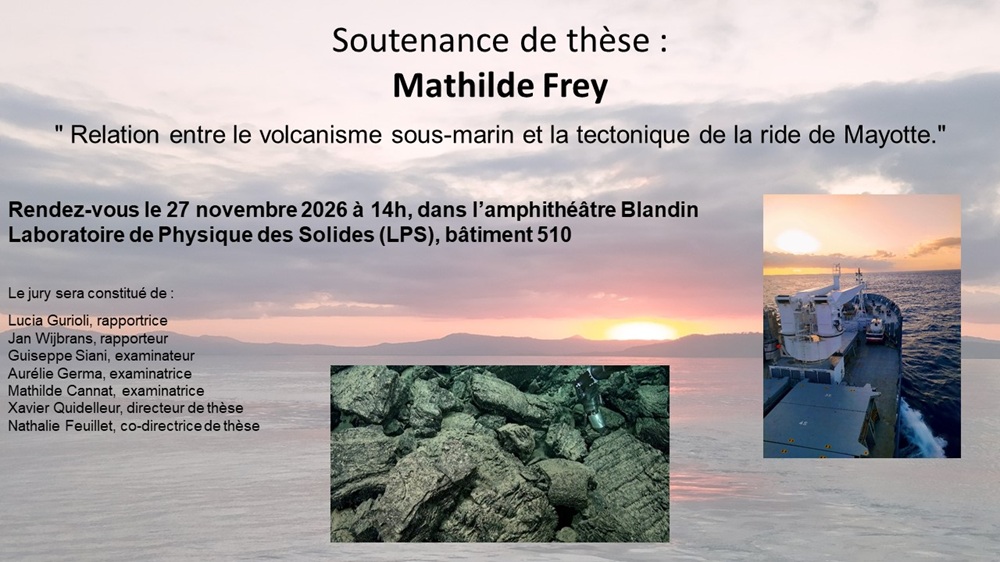
Title: The Relationship Between Submarine Volcanism and the Tectonics of the Mayotte Ridge
Abstract:
In May 2018, a major volcano-seismic crisis began offshore of Mayotte (Mozambique Channel), leading to the formation of a new submarine volcano, Fani Maoré. The latter is located ~50 km offshore from Mayotte, at the eastern end of the East Mayotte Volcanic Chain (EMVC). This chain, extending from Petite-Terre to the east of Fani Maoré and oriented N100°E to N130°E, consists of numerous monogenetic cones, domes, and lava fields. The EMVC includes a remarkable volcanic structure with a U-shaped morphology, the Horseshoe, located 10 km from Petite-Terre. This potentially active structure is associated with seismic swarms and liquid CO2 venting.
The aim of this thesis is to establish the spatiotemporal framework of this submarine volcanism by providing radiometric ages with from a set of samples distributed throughout the EMVC, as well as to test the K-Ar dating analytical protocol adapted to young submarine rocks. This temporal framework will improve our understanding of the history of Mayotte’s submarine volcanism and allow the Evolution of Mahoran volcanism to be traced and placed within the framework of the volcanism of the Comoros archipelago. This thesis is based on a geochronological approach to characterize the dated volcanic edifices. The analysed samples, collected from volcanic cones, domes and lava flows, were sampled during nine oceanographic campaigns using a rock dredge and the Remotely Operated Vehicle Victor6000. In total, 33 samples, ranging from basanites to phonolites, were dated using K-Ar and 40Ar/39Ar techniques on a carefully selected fraction of the groundmass. The unspiked Cassignol-Gillot technique used during this thesis enabled the dating of very young samples with radiogenic argon contents as low as 0.1%.
The 40Ar/39Ar technique was applied to selected samples to strengthen K-Ar ages results and confirm the presence of initial atmospheric 40Ar/36Ar contamination through inverse isochrons. The resulting ages range from 3.74 ± 0.08 Ma to 3.0 ± 1.0 ka. Submarine volcanism therefore appears to have begun in the Northern part of the EMVC at least ~3.7 Ma ago. The EMVC, a Plio-Quaternary chain, developed from ~1.5 Ma onward, and its volcanic activity has continued to the present day with Fani Maoré and the Horseshoe region, where the most recent identified magmatic activity is dated at 3.0 ± 1.0 ka. The temporal distribution indicates that volcanic activity occurred during nine main volcanic episodes, separated by intervals of approximately 50 to 200 ka. Some of these events are contemporaneous with other volcanic events that occurred in the Comoros archipelago. These episodes are interpreted as resulting from rifting accompanied by dike emplacement events, induced by regional tectonics and potentially related to the development of a transfer zone between the East African Rift and the Madagascar grabens. However, the similar orientation of the EMVC and the submarine volcanic ridges of the archipelago may also be interpreted as a resulting from the reorganization of the Lwandle and Somali plates, with the archipelago forming the boundary between these two plates. The ages obtained in the Horseshoe region highlight intense volcanic activity, both explosive and effusive, during the Holocene and suggest that this volcanic region may still be active today. Finally, this study, combining K-Ar and 40Ar/39Ar dating methods, validates these techniques for dating young submarine volcanic rocks, thereby providing a new perspective for understanding the evolution of recent submarine volcanic fields and the associated volcanic hazard assessments.