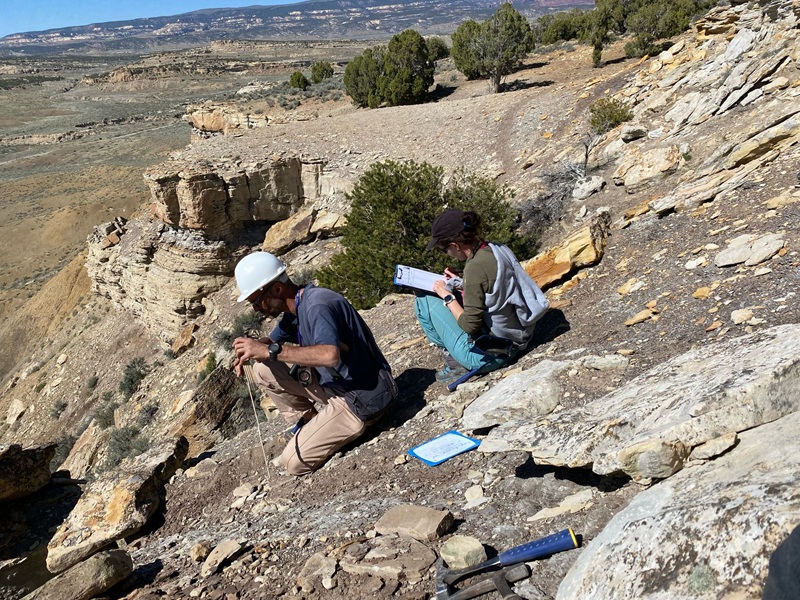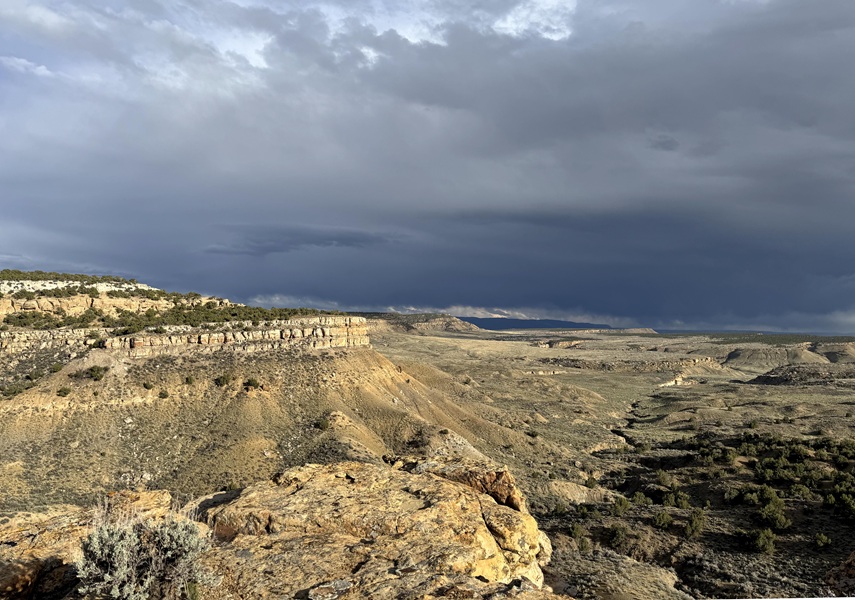
As part of the AMORES project, which aims to understand and model the formation of clay-rich estuarine and shoreface sandstone bodies, a field mission was carried out from September 7, 2024, to April 20, 2025, in Rangely, Colorado, USA. It was organized by the EPOC laboratory (Perrine Mas and Raphaël Bourillot), in collaboration with GEOPS (Benjamin Brigaud, Éric Portier) and Ageos (Julie Champagne). The objective of this mission was to collect sandstone samples, record sedimentological logs, and photograph the Sego Sandstones (Campanian, Upper Cretaceous) using a drone. This formation consists of sandstones deposited in a paleoestuary located on the western edge of the Western Interior Seaway.
Analysis of the facies observed in the outcrops of this formation reveals a vertical aggradation of more than 50 meters of deposits, formed in a shallow marine environment (estuary, shoreface, and delta) north of Rangely, Colorado. The stratigraphic logs produced, as well as the numerous panoramas taken in the field, make it possible to identify vertical and lateral variations in facies, with a typical succession of tidal bars followed by shoreface sands. The samples, placed in their paleo-environmental context, will be used to produce thin sections for microscopy studies (photonics, electron microscopy, and cathodoluminescence) to identify the presence or absence of clay coating around detrital grains. The ultimate goal is to obtain a digital outcrop, similar to subsurface reservoirs, in order to model this formation in 3D and characterize its heterogeneity and connectivity. This model can be compared or used to refine the modeling of flows in sandstone geothermal reservoirs, similar to those in the Albian Sands of the Paris Basin.
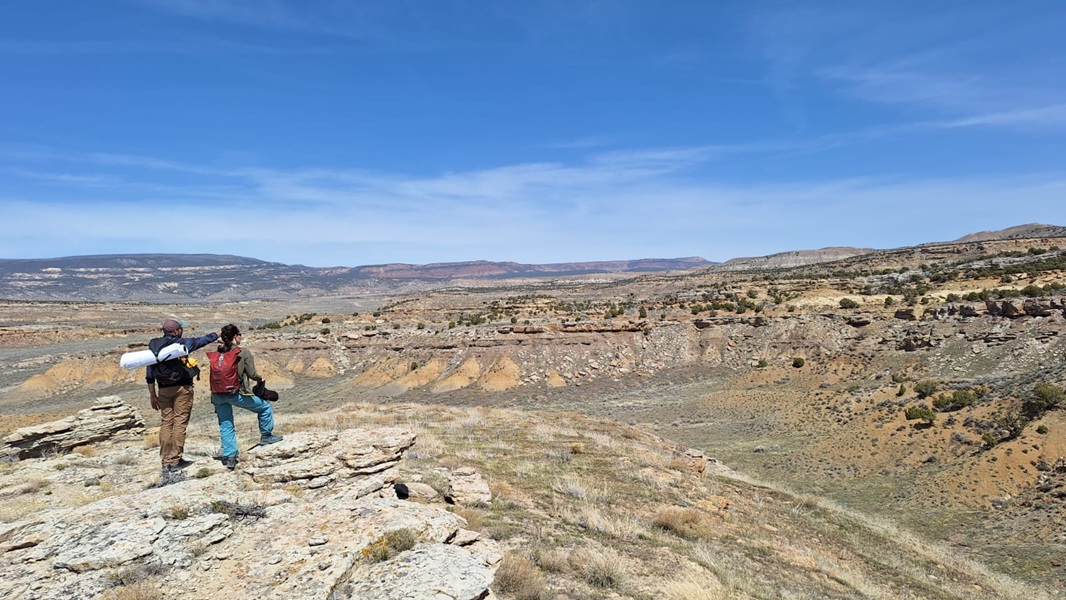
Field mission in Colorado, USA