
Electrical measurements
Description of the instrument:
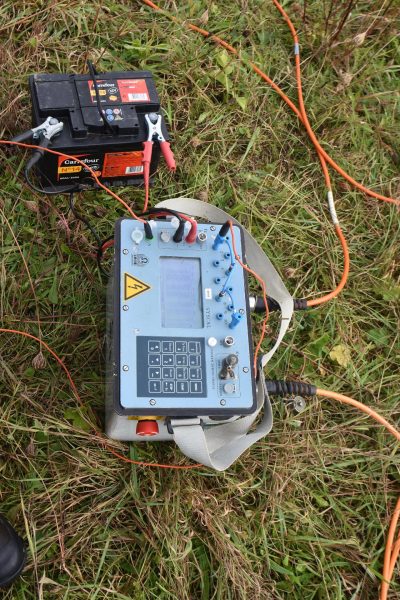
The SYSCAL PRO (manufactured by IRIS INSTRUMENTS) is used to perform electrical resistivity tomography (ERT). It consists of a central unit that combines the functions of current injection and measurement of the resulting electrical potential difference. This unit is powered by a 12V battery, similar to a car battery. Multi-electrode cables are used to connect electrodes with different spacings depending on the site and the object being studied (1 m, 5 m, and 10 m). The device configuration and measurement sequence (which tells the device the different measurements it must perform) are set using a computer and dedicated software.
Contacts:
Marc Pessel: marc.pessel@universite-paris-saclay.fr
Principle of analysis:
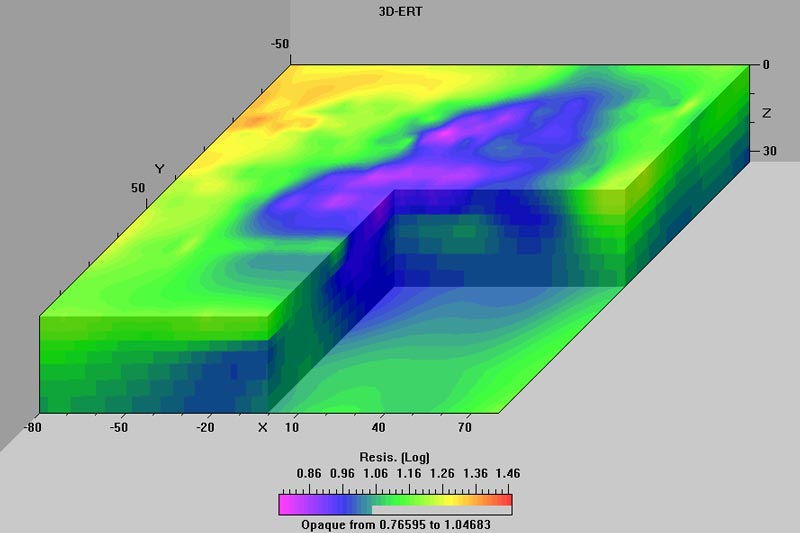
The objective of electrical prospecting is to determine the distribution of electrical resistivity values in the subsoil based on measurements taken at the surface or in boreholes. To do this, two cables with 24 electrodes spaced 1, 5, or 10 meters apart are used. The electrical resistivity of a formation can be deduced from the apparent resistivity, a quantity calculated from the potential difference between two electrodes during the injection of a direct current between two other electrodes. This apparent resistivity then depends on the arrangement of the electrodes and the distribution of resistivities in the ground. Different geometric arrangements of the electrodes are possible (Wenner, Schlumberger, or Dipole-dipole protocols), each with a certain sensitivity to the way in which the resistivity of the medium under study varies.
The depth of investigation increases with the size of the device used: the greater the spacing between the electrodes, the deeper the measurement (around ten meters for a spacing of 1 m, to around a hundred meters for a spacing of 10 m). However, this increase in depth is accompanied by a decrease in resolution.
Description of the instrument:
The laboratory has several instruments for measuring conductivity by electromagnetic induction.
Among them are SLINGRAM-type instruments with sensitivity at shallow depths (0 to 30 m):
– a CMD-MiniExplorer (manufactured by GF INSTRUMENTS) consisting of a probe and a control unit. Equipped with GPS and carried on a pole parallel to the ground, the CMD provides rapid, contactless mapping of the near surface (0 to 1.8 m).
– a PROMIS (manufactured by IRIS INSTRUMENTS) using a transmitter loop carried by an operator, powered by a battery belt and connected by a cable to a receiver equipped with a magnetic sensor. The analysis is multi-frequency (from 110Hz to 56KHz) and the device can measure the three components of the induced magnetic field (one vertical component and two horizontal components). This device allows for investigation to a depth of several tens of meters.
– An EM31 that can be used via the GEOFCAN network, of which we are a partner: https://geofcan.inrae.fr
The laboratory also has passive electromagnetic measuring instruments (MT/AMT) that can also be used with very low frequency transmitting antennas (“Controlled Source”) for great depths (100m – 10km):
– Equipment from the CRITEX national park linked to WP6.5 – CSAMT, including two transmitters (sources), a Phoenix T3 and a Geometrics EH4, supplemented by receivers (Phoenix and Metronix): https://www.critex.fr/instruments/wp6-explorer-sous-la-surface/tache-6-5-source-magneto-tellurique-audio-controlee-cs-amt/?lang=fr
– In addition, the laboratory has access to the equipment of the EMMOB national park, which consists of Metronix instrumentation: https://ites.unistra.fr/parc-emmob