We are pleased to welcome Isis Criouet (post-doc in Liège) on Thursday, February 5, at 2 p.m. on the 2nd floor of Building 504 for a seminar entitled: “Origin and preservation of organic compounds in the Martian subsurface: what clays have to tell us.”
Abstract:
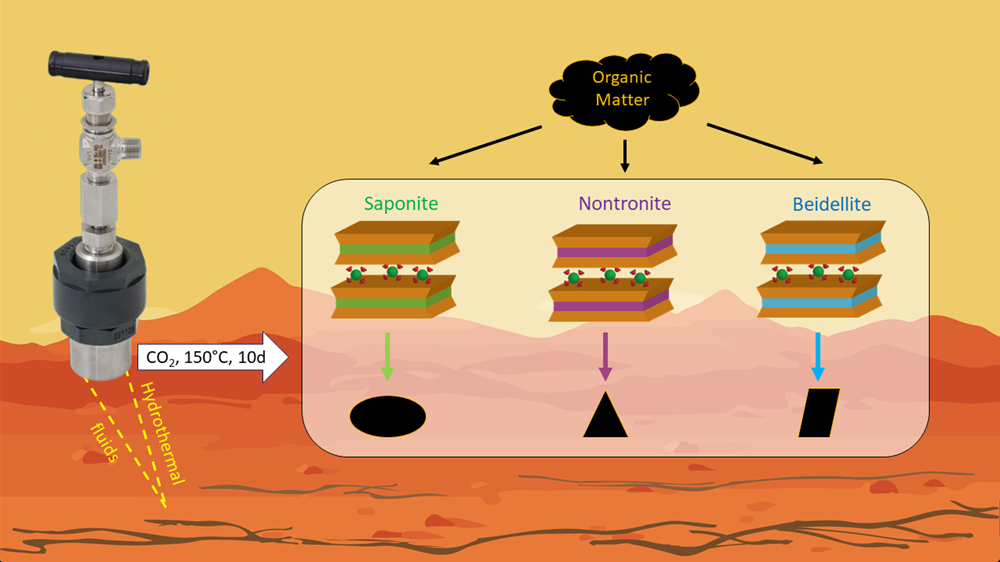
Nearly half of the Martian surface consists of very ancient terrain, formed during the Noachian period (> 3.7 Ga). The geomorphological characteristics of this terrain (paleolakes, ancient hydrographic networks), combined with the presence of hydrated minerals (mainly clays), indicate the past existence of liquid water on the surface. Among these minerals, smectites, formed by the aqueous alteration of the primitive Martian crust, are prime targets for the search for potential traces of ancient life. On Earth, these minerals are known for their ability to trap and preserve organic matter within their crystalline structure. However, the presence of sulfate veins cutting across these deposits indicates the circulation of diagenetic or hydrothermal fluids after their formation, which may alter the initial chemical signal of the trapped carbon compounds. To better understand these processes, we have developed experimental model systems to study the interactions between organic molecules and synthetic smectites of various compositions under conditions representative of the Martian environment. This approach aims to assess the influence of the crystallochemistry of these minerals on the stability and transformation of organic matter throughout Martian geological history. The knowledge gained will help refine strategies for detecting and interpreting potential biosignatures during future exploration and sample return missions.