
Mission Mingulay-Rockall
(juin 2016)
Funding: IFREMER (2016)
Expedition leaders: Mr Elliot and C. Colin
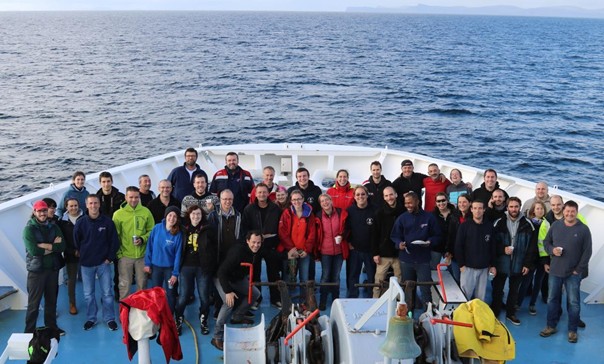
Onboard team:
LPGNantes (University of Nantes)
GEOPS
LSCE
National University of Ireland, Galway
University of Ghent
The Mingulay-Rockall Expedition (June 2016) aboard the Atalante aimed to collect water samples and sediment cores from areas rich in deep-sea coral debris deposits, in order to use these archives for paleoceanographic reconstructions.
Two sampling sites were studied in particular during this mission:
1/ The Mingulay site (in the Hebrides Sea), characterised by the presence of cold-water coral reefs (L. pertusa) currently thriving at depths of between 100 and 150 metres.
2/ The Logachev site (south-west of the Rockall Channel), which is also characterised by abundant coral colonies (L. pertusa and M. oculata) but at greater depths of around 750 m.
This project therefore aims to conduct a multidisciplinary study (sedimentology, biology and geochemistry of corals) to reconstruct the growth history of these reefs as well as environmental changes (temperature, circulation of subsurface and intermediate waters) during the Holocene based on these two sites. We will therefore obtain reconstructions of the hydrology of subsurface and intermediate waters with unprecedented temporal resolutions at two sites, at different depths.
This project brings together British, Irish and French researchers and forms part of a national research initiative aimed at studying deep-water coral ecosystems and using fossil corals as natural archives to reconstruct past palaeoclimatic changes at high resolution (ANR HAMOC PI C. Colin).