
Intercalibration of 40Ar/39Ar and radiocarbon in Europe between 10,000 and 40,000 years BP.
Project leader: Alison Pereira
Other GEOPS members involved: Giuseppe Siani, Frédéric Haurine
Funding source: INSU Call for Projects, LEFE-IMAGO (duration: 2022–2024)
Institutions and members involved in the project:
GEOPS (France): Alison Pereira, Giuseppe Siani, Frédéric Haurine
LSCE (France): Sébastien Nomade, Christine Hatté
EDYTEM (France): Anne-Lise Develle, Erwan Messager
IGAG-CNR (Italy): Biagio Giaccio
INGV (Italy): Roberto Isaia
University of Pisa (Italy): Roberto Sulpizio
Swansea University (United Kingdom): Paul Albert
University of Cologne (Germany): Bernd Wagner
The ICARE project is an intercalibration project between the radiocarbon (14C) and 40Ar/39Ar radioisotopic dating methods. It aims to improve the accuracy and precision of the recently published IntCal20 calibration curve, between 12,000 and 40,000 years, particularly beyond the calibration range covered by dendrochronology, by obtaining radioisotope pairs that serve as independent and precise chronological markers. Ideally, the 14C calibration curve should be based on atmospheric 14C records, dated independently and absolutely. Intcal20, as well as previous calibrations, rely in particular on tree-ring counting (dendrochronology), which provides excellent continuous records of atmospheric 14C for the last 13,900 cal BP. For earlier periods, the calibration curves incorporate ‘floating’ chronologies obtained from the simultaneous dating of lacustrine and marine sediments, speleothems or corals (14C combined with varve counting, U/Th dating or biostratigraphic correlations). However, the methodological issues inherent in each of these chronologies lead to increased uncertainties in the calibration curve beyond 14,000 years, reaching in particular 1,000 years or more between 35 and 50 ka.
Against this backdrop, the aim of the ICARE project is to increase the number of chronological control points on the IntCal20 calibration curve through the simultaneous use of 40Ar/39Ar (volcanic eruption dating) and 14C methods. The 40Ar/39Ar method is primarily used for dating ancient potassium-rich volcanic deposits; however, recent methodological advances now allow for the highly precise and accurate dating of ‘sanidine’ or ‘leucite’ minerals with uncertainties of around 1%, even for rocks/eruptions between 15 and 50 ka (Giaccio et al., 2017; Albert et al., 2019). The Mediterranean basin, at the heart of our project, is an ideal area for the simultaneous use of 40Ar/39Ar and 14C chronometers. Indeed, the southern part of the Italian peninsula has been subject to intense explosive ultra-potassic volcanic activity over the last 50 ka. Certain volcanic sources, notably Vesuvius, the Phlegraean Fields, Etna and Ischia, have led to the deposition of numerous ash layers (tephra) in neighbouring areas, both on land and at sea (Siani et al., 2004; De Vito et al., 2008; Albert et al., 2019). The eruptions covered by this project are suitable for 40Ar/39Ar dating because the associated deposits contain minerals that are very rich in potassium and often several millimetres in size.
In the ICARE project, more than ten major volcanic eruptions originating from the volcanic provinces of southern Italy will be dated directly via 40Ar/39Ar on single crystals and indirectly via radiocarbon dating (seeds, charcoal or twigs using AMS Artémis (Accelerator for Research in Earth Sciences, Environment and Museology) or AMS 14C MICADAS. In addition to contributing to the improvement of IntCal20, this project also aims to provide new 14C age estimates for the marine reservoir in the Mediterranean basin through the direct correlation of 14C ages obtained from terrestrial and marine records in which eruptions are identified (via geochemical analyses) and/or dated.
This project focuses on the study of three distinct types of records shown in the figure: 1) Sequences located close to volcanic sources (Vesuvius, Phlegraean Fields); 2) The lacustrine sedimentary record of Lago Grande di Monticchio, a continuous sequence from southern Italy covering the last 133 ka (Wulf et al., 2004). 3) Two marine cores from the Adriatic Sea, MD-90-917 (41°17’ N, 17°37’ E, 1010 m) and MD-90-916 (41°30’ N, 17°58’ E, 1150 m) containing tephra (volcanic ash layers) which have been geochemically identified as corresponding to selected eruptions near the sources and at Monticchio over the last 20 ka (Siani et al., 2004).
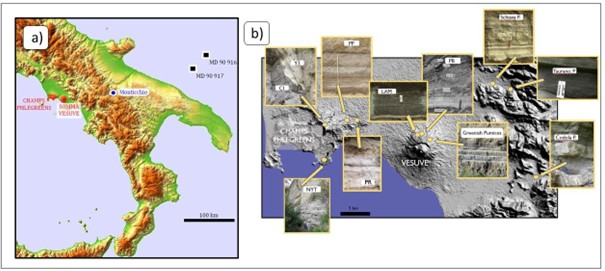
a) Topographic map of southern Italy showing the volcanic complexes of the Phlegraean Fields and Vesuvius, as well as the Monticchio site and the marine cores to be studied (MD 90 916 and MD 90 917).
b) Major eruptions to be sampled as part of this project in the proximal volcanic zone. CI: Campanian ignimbrite; Y3: Monte Masseria; NYT: Neapolitan Yellow Tuff; PR: Ponti Rossi sequence; PP: Pomici Principal; LAM: Lagno Amendolare; PB: Pomici di Base.