
HYDROSED
« Exploring paleo-hydrology and its impact on sedimentary dynamic processes in the South China Sea » / MD 215
Funding: IFREMER
Project leader: C. Colin (GEOPS)
Expedition leaders: C. COLIN (GEOPS, France), Z. LIU (Tongji University, China) and A. Tien-Shun LIN (National Central University, Taiwan),
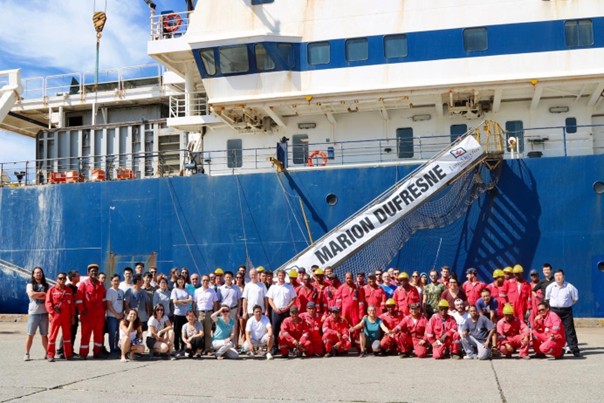
Onboard scientific team: 35 researchers and students from France (GEOPS, LSCE, IFREMER and LOG laboratories), China (Key State Laboratory of Marine Geology, Tongji University) and Taiwan (Department of Earth Sciences at National Central University, National Sun Yat-sen University and Institute of Oceanography at National Taiwan University).
The MD215 HYDROSED oceanographic expedition aboard the Marion Dufresne collected long marine sediment cores and seawater samples in the northern South China Sea. The main scientific objective of this mission is to reconstruct the past hydrology of intermediate and deep water masses, as well as the climate of the Southeast Asian region, and to assess their impact on the dynamics of sediment transport on the ocean floor and land–sea transfers. The samples collected during the HYDROSED oceanographic campaign will enable:
- A better understanding of the origin and past variations of the intermediate and deep water masses in the northern South China Sea and their relationships with glacio-eustatic changes, the evolution of the global thermohaline circulation (Great Conveyor Belt) and regional climate changes;
- Reconstruct past climate variability in Southeast Asia (the East Asian monsoon and the ENSO system) at very high temporal resolution and establish its potential impacts on deep-sea sedimentation in the northern South China Sea;
- To reconstruct past sediment transport dynamics from the continents (Taiwanese rivers) to the northern South China Sea using a ‘source-to-sink’ approach, and to establish the climatic controls (paleotyphoons, paleomonsoons and sea-level changes);
- To develop and/or improve geochemical tracers used for paleo-oceanographic reconstructions and enhance our understanding of the distribution of neodymium (Nd) isotopes and rare earth element (REE) concentrations in a marginal sea heavily influenced by massive discharges of freshwater and sediments from several Asian rivers.