Sensitivity of thermohaline circulation in the Mediterranean Sea: lessons from the past for the future – MedSens
Funding: MedSens (2020–2023)
Project leaders: K. Tachikawa (CEREGE, Aix-Marseille), C. Colin (PI – GEOPS)
Collaborators: C. Colin (GEOPS), G. Siani (GEOPS), S. Sepulcre (GEOPS), F. Haurine (GEOPS), G. Wei (GEOPS), M. Revel (Géoazur, Nice), K. Tachikawa (CEREGE, Aix-Marseille), L. Vidal (CEREGE), T. de Garidel-Thoron (CEREGE), L. Beaufort (CEREGE), J.C. Dutay (LSCE), G. Ramstein (LSCE), L. Li (LMD).
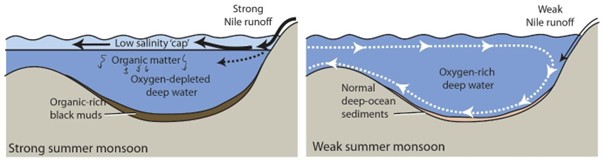
The aim of the MedSens project is to assess the sensitivity of Mediterranean circulation to hydrological/thermal disturbances under warm-climate conditions with strong seasonality, which may serve as an analogue for future climatic conditions. To address this issue, we will combine (1) reconstructions of Mediterranean conditions during large-scale disturbance events based on several tracers, including the isotopic composition of Nd analysed in autogenic phases, with (2) numerical simulations obtained using a regional model with high spatial resolution (1/8º) that incorporates the evolution of certain circulation tracers. We will focus on the analysis of sedimentary layers rich in organic matter, known as ‘sapropels’, deposited during periods of stagnant circulation in the Mediterranean. We will be particularly interested in the S5 sapropel formed during the last interglacial period, a warm period comparable to the warming simulated for the near future. We will apply a suite of complementary tracers (geochemistry and micropalaeontology, including potential new tracers) to a series of sediment cores located along a zonal transect in order to propose a robust reconstruction. The MedSens project is based on a consortium of partners with complementary expertise: reconstruction based on tracer analysis (CEREGE/GEOAZUR and GEOPS) and numerical modelling (LSCE/LMD).