AMARYLLIS-AMAGAS II Oceanographic Mission
Principal Investigators
Aline Govin (LSCE, France) and Cristiano M. Chessi (USP, Brazil)
Co-leader
Charlotte Skoniecnzy (GEOPS)
M2 student
Morgane Lefeuvre (M2 ECLAT, Université Paris-Saclay)
Funding
French Oceanographic Fleet, CNRS (IRP SARAVA), IPSL-CGS, CAPES-COFECUB*
Website
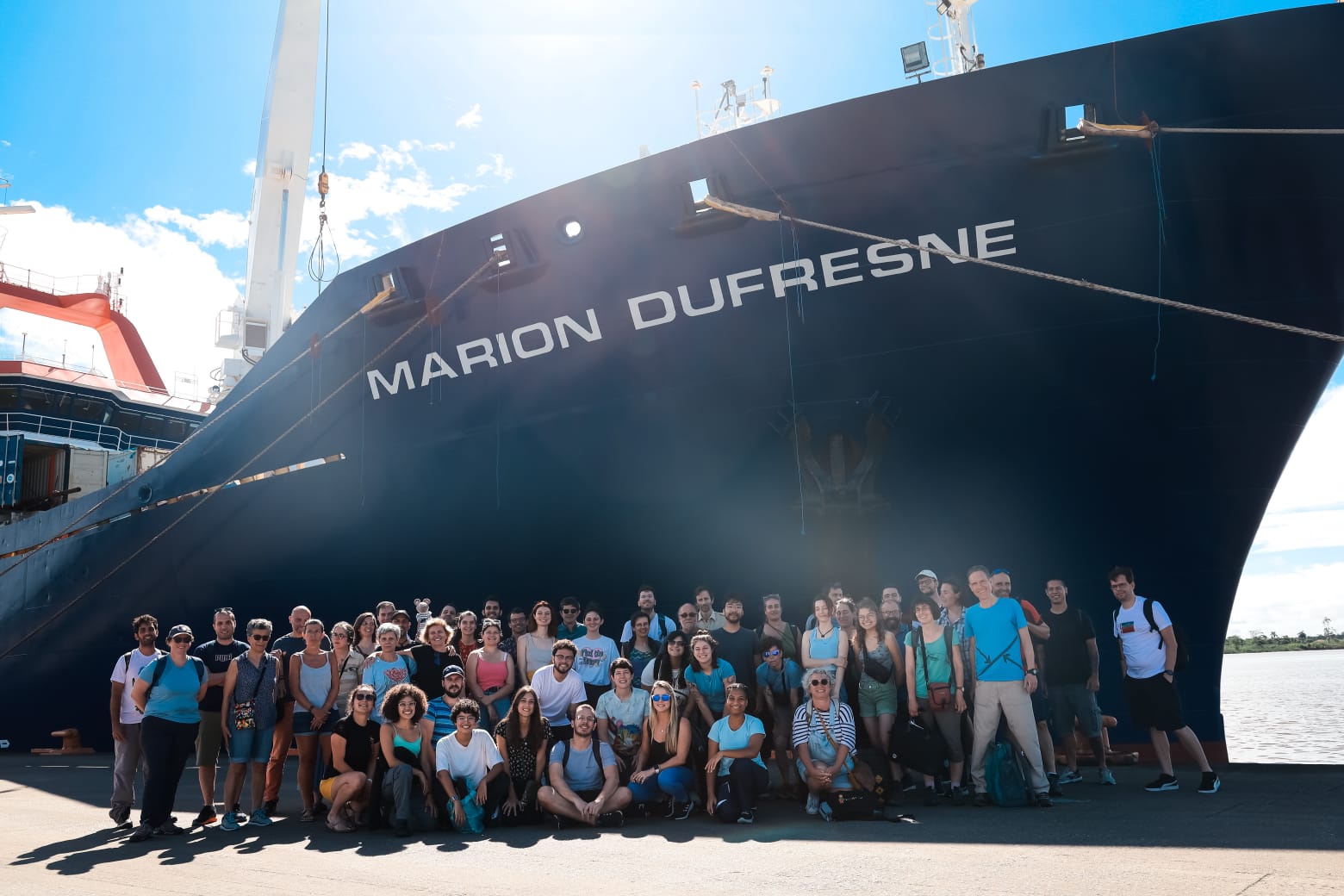
The mission took place in two phases aboard the French research vessel (R/V) Marion Dufresne, lasting a total of 49 days, comprising 27 days for the first phase and 22 days for the second phase. It began in Bridgetown (Barbados) on 16 May 2023, stopped in Paramaribo (Suriname) on 11–12 June 2023 for the change of leg, and ended in Recife (Brazil) on 3 July 2023.
The AMARYLLIS-AMAGAS mission aims to better establish the major but uncertain role played by the Amazon region in the Earth’s global climate system. Its role as a terrestrial carbon sink depends on processes that are still poorly understood: the intensity and distribution of continental precipitation, soil fertilisation by Saharan dust, and the potential stability of gas hydrates formed in the area where sediments transported by the Amazon River accumulate (hereinafter referred to as the ‘Amazon cone’).
Given these uncertainties, the mission has four main scientific objectives:
(1) to reconstruct the past climate history of the Amazon and north-eastern Brazil, in terms of regional variability and the mechanisms controlling precipitation and vegetation, across different timescales over the last few million years (ranging from the anthropogenic timescale to that of millennia and orbital cycles) ;
(2) to assess the contribution of Saharan dust deposited in this region, both at present and over the last few million years, in particular its role as a fertiliser for the Amazon rainforest;
(3) to examine the relationship between gas hydrates and large-scale submarine landslides in the upper part of the Amazon cone, by assessing fluid circulation and the physical properties of sediments;
(4) to assess the extent of gas emissions into the ocean across the Amazon cone as a whole.
Mission report: https://doi.org/10.13155/98738