
The carbon cycle
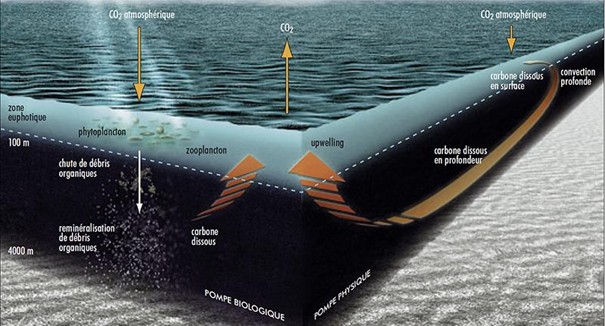
Measurements of CO2 trapped in Antarctic ice reveal that atmospheric pCO2 during glacial periods was ~50–100 ppm lower than the pCO2 levels recorded during interglacial periods prior to human activity. Studies also show a close correlation between atmospheric pCO2, ice volume and Antarctic temperatures, suggesting that pCO2 acts as a driving or amplifying factor in glacial/interglacial cycles, and highlighting the importance of the high southern latitudes in rapid palaeoclimatic changes. A key element of thermohaline circulation is the return flow of deep water masses to the surface via the Antarctic divergence. This mechanism, known as the ‘physical pump’, partly controlled by the latitudinal position and intensity of the westerlies, influences the transfer of heat and carbon from the deep ocean reservoir to the surface ocean and the atmosphere, with a significant global impact. Furthermore, the action of the physical pump is complemented by that of the ‘biological pump’, corresponding to the transfer of particulate carbon (organic or inorganic) from the ocean surface waters to the deep ocean via the respective activity of primary producers and calcareous plankton, which could explain a significant proportion of the changes in atmospheric pCO2 during the last deglaciations. However, few studies have examined the coupled action of physical and biological pumps in the past. Furthermore, the relationships between the mechanisms of physical and biological pumps at the surface and the deeper compartments of the ocean are poorly understood. Reconstructions of changes in the carbon cycle in intermediate and deep water masses, and of transfers to the surface, rely on the recent development of geochemical tracers measured in fossils (notably benthic foraminifera) such as elemental ratios (Mg/Ca, Sr/Ca, U/Ca) and/or 14C. Given that over 90% of the organic carbon sequestered in the marine environment is found in continental margin sediments, our research also aims to improve coastal carbon budgets, particularly in fjords, which are ‘hotspots’ for the long-term storage of organic carbon of marine and terrestrial origin.
Research Objectives: The aim of our research is to reconstruct the dynamics of southern upwellings, changes in the efficiency of the southern biological pump, and inputs of terrestrial organic carbon from the Recent to the last 800 ka, in order to understand their impact on past changes in atmospheric pCO2.
List of permanent and non-permanent staff:
C. Colin, S. Alphonse-Duchamp, G. Siani, E. Teca, S. Sepulcre, S. Bertrand, R. Cole