
Dating and methodological developments
Our team has developed numerous methodological approaches to decipher the evolution of volcanic and planetary landscapes. Dating is a key aspect of quantifying evolutionary processes, which we are refining through isotopic geochemistry techniques. We are also developing digital tools for analyzing remote sensing data to characterize planetary surfaces.
Methodological developments are addressed in the following research areas:
- K-Ar and 40Ar/39Ar geochronology
- In situ K-Ar dating, applied to future Mars missions or terrestrial samples
- Digital Terrain Models of terrestrial volcanoes, Mars, the moon Europa, and exoplanets.
- Light-matter interaction (spectrophotometry).
- Cratering and impact flux
Geochronology K-Ar and 40Ar/39Ar
The development of argon geochronology (K-Ar and Ar/Ar techniques) is a specialty of the GGPV team that is recognized internationally. These techniques now enable us to date volcanic rocks and minerals spanning most of Earth’s history. We are continuing our efforts to date younger ages through the development of a new automated K-Ar line and its low-volume spectrometer (the Pandora line).
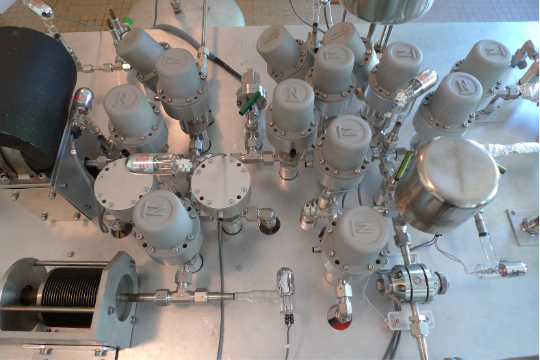
Pandore Automated Line for K-Ar Dating at Cassignol-Gillot
In situ K-Ar dating, applied to future Mars missions or terrestrial samples
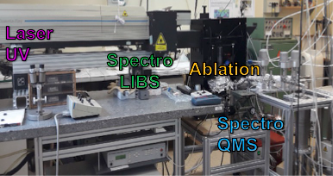
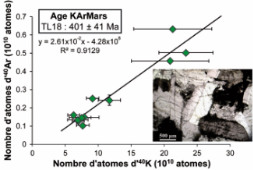
We are also developing in-situ K-Ar dating in the laboratory. During sample ablation using a UV-YAG laser, potassium is measured using LIBS, and argon is measured using a quadrupole mass spectrometer. The KARMARS instrument (Cattani et al., 2019) has demonstrated the feasibility of in-situ K-Ar dating applied to Martian rocks, with basaltic compositions and ages up to 400 Ma
Digital Terrain Models of terrestrial volcanoes, Mars, the moon Europa, and exoplanets
Determining topography using accurate digital elevation models (DEMs) is key to understanding landscape evolution. We are developing methods to determine these DEMs as robustly and accurately as possible. Additionally, we are interested in microscale roughness, which also provides crucial information on surface processes (wind transport, water transport, weathering). We are developing multifractal theory to characterize and generate realistic synthetic topographies (for example, for exoplanets).
Funding: CNES/CNRS/INSU National Planetology Program
People involved: F. Andrieu, F. Schmidt, P. Lahitte
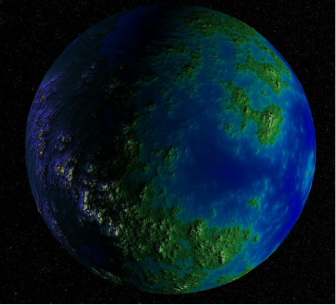
A synthetic topography of an exoplanet, generated using a multifractal simulation. You can view the 3D model
online here: https://data.ipsl.fr/exotopo
Light-matter interaction (spectrophotometry)
A key to understanding the processes occurring on the surfaces of planets lies in determining the surface’s microphysical characteristics. Our team is developing innovative tools to determine the roughness, composition, porosity, and grain size of planetary regoliths. To do this, we use multi-angle, multi-wavelength remote sensing techniques and develop numerical methods for data inversion and assimilation.
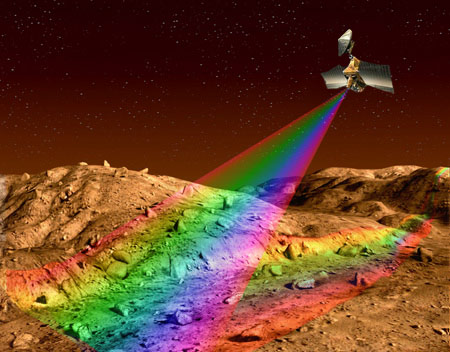
Financement : CNES/ESA : OMEGA (CoI F. Schmidt), PFS (CoI, F. Schmidt), ExoMars (GI, F. Schmidt)
Personnes impliquées : F. Andrieu, F. Schmidt, G. Cruz Mermy
Cratering and impact flow
Quantifying the current impact flux on Earth is crucial for calibrating the cratering rate of planetary surfaces. It determines the accuracy of Mars’ relative chronology in particular.
Our team is developing two projects: FRIPON for the detection of lunar flashes and ACDC for the automatic detection and characterization of craters using artificial intelligence tools.
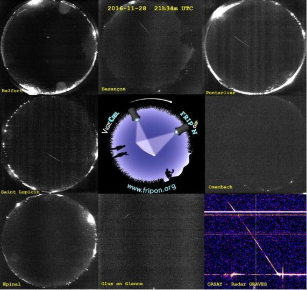
Fireball observed over the Jura on November 28, 2016, at 9:14 p.m. UTC by seven FRIPON cameras and the Graves d’Orsay radio station (bottom right)