
Mars and the outer planets
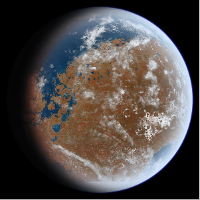
Our team focuses on planetary evolution and early processes dating back several billion years. In the early stages of planetary formation, our research projects examine the formation of the first crusts and atmospheres. We model the thermal evolution of a primitive magma ocean in relation to its primordial atmosphere. On Mars, the transition between the Noachian and Hesperian epochs is crucial for understanding the evolution of the water cycle and its impact on geomorphology. We focus on the distinctive morphology of certain valley networks on Mars’s cratered plateau, which exhibit morphological transitions suggesting a spatial and temporal evolution of hydrological dynamics. The role of Tharsis on the regional hydrosphere is studied in this context. Finally, we analyze the dynamics of tsunamis on Mars and the role of a transitioning ocean. This is done through high-resolution image analysis and climate modeling in collaboration with NASA’s Goddard Space Flight Center (USA).
Models of Thermal Evolution: Ocean, Primitive Magma, and Atmosphere
The cooling of magma oceans (MO) on young terrestrial planets shapes early environments, both in terms of the initial conditions of solid mantle dynamics and the chemical cycles of volatile species, as well as the eventual formation of oceans. Working with a multidisciplinary team, we developed a coupled MO-atmosphere model. We have thus shown that the formation of a water ocean depends not only on the planet’s size and its distance from the Sun, but also on the initial concentrations of H₂O and CO₂ (Lebrun et al. 13, Salvador et al. 17). Furthermore, when a solid lithosphere begins to form, heat transfer and the transport of volatiles are altered; it is therefore important to fully understand this transitional geodynamic regime, as well as the coupling between mechanical behavior, volatile content, and heat transfer.
People involved: H. Massol (GEOPS), A. Davaille (FAST, U. Paris Saclay), Ph. Sarda (GEOPS), G. Delpech (GEOPS), C. Pallares (GEOPS)
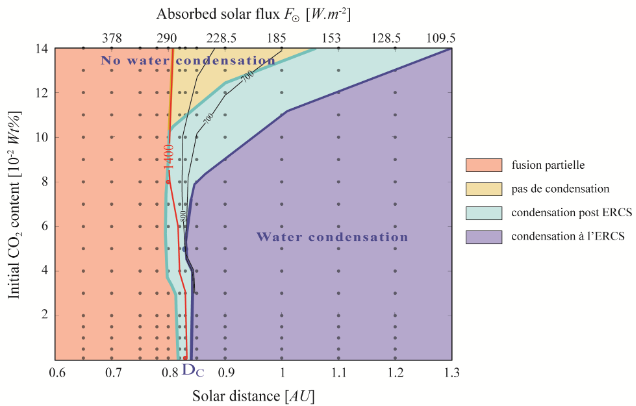
Surface conditions of an Earth-like planet at the end of the Magma Ocean phase (Massol et al., subm.)
The Origin and Formation of the Martian Highlands
Curiosity’s in situ observations of possible remnants of the continental crust, the recent discovery of differentiated crustal clasts in the Martian meteorite NWA7533 (Hewins et al. 2017), and the identification of a crustal block in the Terra Cimmeria Sirenum region (Bouley et al., 2020) offer new insights into the origin and formation of the Martian Highlands.
Tsunamis on Mars
The recent discovery of images showing lobed flow fronts observed in the Arabia Terra region provides evidence of successive waves associated with one or more tsunami events (Costard et al., 2017). These flows extend more than 150 km inland, even surpassing the limits of the paleo-shores mapped by Parker (1993), and climb slopes to altitudes of several tens of meters. These formations exhibit all the characteristics of terrestrial tsunami deposits. Using a numerical model developed by K. Kelfoun (Univ. Clermont-Ferrand), we were able to trace the origin of the tsunami by identifying the impact craters potentially responsible for these tsunamis. The discovery of these tsunamis on the paleoshorelines of Mars’s northern hemisphere reignites the debate over the existence of an ocean and thus the stability of liquid water on this planet. Are the tsunamis identified in the Arabia Terra region unique, or do they instead result from multiple events, as one might expect?
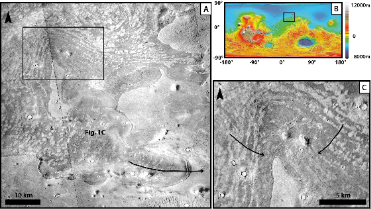
Presumed lobed deposits from mega-tsunamis on Mars along the paleoshorelines in Arabia Terra (shown in the inset)
Mars’ ancient climate and ocean
The presence in the Northern Hemisphere of a circumpolar ocean and megatsunami deposits along paleocoasts has been estimated to date back 3 billion years (Costard et al., 2017 and 2019). Previous climate models were unable to simulate a stable ocean during this period: all the water accumulated on the mountains in the form of snow. Studies conducted collaboratively by members of our GEOPS team and NASA/GISS (Schmidt et al. 2022, Schmidt et al., 2025) were able to construct a climate simulation incorporating two new essential components: ocean circulation and the presence of mega-glaciers. By incorporating these two processes, the climate simulations predict a stable ocean in the northern hemisphere, even at average Martian temperatures below 0 °C. The simulations predict the presence of glaciers transporting ice from the highlands to the ocean, consistent with geological interpretations of the images.
Our team conducted a detailed study of the morphology of the largest volcano in the Solar System to understand the history of water in Mars’s more distant past. We were able to show that Olympus Mons has features consistent with having formed within an ocean (Hildenbrand, 2023).
People involved: H. Massol (GEOPS), A. Davaille (FAST, U. Paris Saclay), Ph. Sarda (GEOPS), G. Delpech (GEOPS), C. Pallares (GEOPS)
Weathering on early Mars
Project: Weathering Profiles on Early Mars
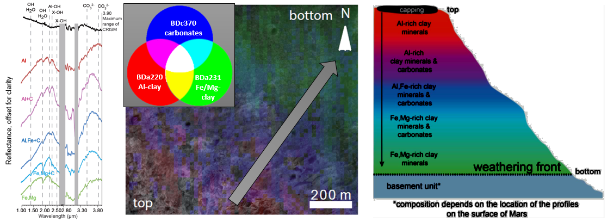
Left: Orbital data (near-infrared spectroscopy). Center: Weathering profile color-coded according to the compositions of the different weathering horizons. Right: Schematic diagrams of weathering profiles on Mars (Bultel et al., 2019).
Noachian Martian surfaces (>3.8 Ga) feature vertical assemblages of weathering horizons known as weathering profiles. Their presence indicates past weathering by liquid water. This implies a warmer and wetter climate during the Noachian period than exists today. Such a climate requires a greenhouse effect sustained by a CO2-rich atmosphere denser than today’s (combined with other greenhouse gases). However, the absence of carbonates in such profiles calls these conditions into question. Identifying carbonates mixed with hydrated minerals is difficult. We have established a new spectral criterion that allows us to highlight the presence of carbonates mixed with clay minerals in weathering profiles. Their mineralogy is reclassified as follows: Al-rich clays, Al-rich clays with carbonates, Al-Fe-rich clays with carbonates, Fe-Mg-rich clays with carbonates, Fe-Mg-rich clays. Using terrestrial analogs, geochemical models, and laboratory experiments, these mineralogical assemblages help elucidate water-rock interaction conditions. It is therefore possible to suggest that the profiles formed by weathering occurred via a solution rich in carbonic acid (and likely other acids), with a pH that gradually increased with depth to neutral/alkaline values. The distribution of weathering profiles on the surface suggests that this process occurred on a planetary scale and that the source of CO₂ was likely atmospheric. Our orbital investigations suggest that the Noachian atmosphere on Mars was rich in CO2 and denser than today’s, reconciling climate models, laboratory experiments, geochemical models, and mineralogy observed from orbit.
Person involved: Bultel B.
The ice on the moons and Mercury
The goal of this project is to characterize the surfaces of icy moons and Mercury in order to understand the mechanisms driving their evolution. The icy moons of Jupiter, Saturn, and beyond are planetary bodies of great interest in many respects. Some, including Europa, Titan, and Enceladus, feature deep liquid oceans and geomorphological evidence of cryovolcanism on their surfaces. Europa and Enceladus appear to have plumes ejecting material along faults. The smallest particles are capable of escaping the body’s gravitational pull. It is therefore possible, in this case, to sample the interior of these bodies using a space probe. While the presence of liquid water seems established, several questions remain unanswered regarding cryovolcanism. Our team proposes to address this question by introducing new observational constraints through the study of surface microstructure using photometry (surface analysis at different angles) to obtain information on the nature of the surface. In particular, the micro-roughness and the shape of water grains (smooth/rough) will help us decipher surface geological processes. We have established the photometric diversity of Europa and identified potential plume source regions exhibiting anomalous “forward” scattering behavior (Belgacem et al., 2020). We have unequivocally determined the presence of water ice and sulfuric acid (Cruz Mermy et al., 2023–2025). The next step will be spectrophotometry combining both spectral and geometric data, which will also allow us to quantify the amounts of chemical compounds and their grain sizes (Belgacem et al., 2025). We are also developing models of the microstructure and heat transfer in ice (Mergny et al., 2024–2025).
Since Mercury is the planet closest to the Sun, it has the highest temperature, and ice is not expected to be present. However, due to a very low axial tilt (zero obliquity for several billion years), the poles are always in shadow, and the presence of ice is suspected. The same phenomenon occurs on the Moon. Our team is studying these ices, notably through the BepiColombo mission and the Máni mission.
People involved: F. Schmidt, H. Massol, F. Andrieu, J. Barron, S. Raza (GEOPS), A. Le Gall (LATMOS), C. Mergny (ESA-ESAC, Madrid), G. Cruz Mermy (ESA-ESAC, Madrid), I. Belgacem (ESA-ESAC, Madrid)