
Current Global Processes and Their Impacts
Our team focuses on the processes currently shaping planetary surfaces using a variety of approaches. We study Martian permafrost (structure, distribution, and ice content in the permafrost), current active flows on Mars, and slope instabilities (debris avalanches, gullies on Mars, and thermophoretic effects). These processes are studied using three approaches: field studies, numerical modeling/simulation, and laboratory experiments.
This is addressed in the following research areas:
- Martian permafrost (structure, distribution, and ice content in the permafrost) and its terrestrial analog in the Arctic.
- Degradation of Arctic permafrost due to climate change and human activities
- Seasonal frost and current active flows on Mars
Martian permafrost (structure, distribution, and ice content in the permafrost) and its terrestrial counterpart in the Arctic.
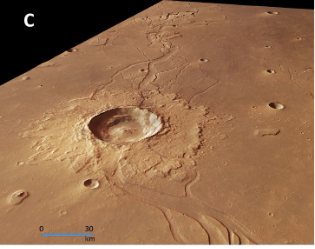
To improve our understanding of Mars’ cryosphere (age, type of ice, etc.), an analysis of the northern plains of Mars (Utopia Planitia) was conducted, where numerous landforms indicating the presence of ice in the ground have been identified (polygons, thermokarst depressions, rock glaciers, etc.). Work has been undertaken to map these landforms and understand the processes involved (sublimation vs. ice melting). To better constrain the origin of these structures, field studies of analogues are being conducted in ice-rich permafrost regions in the Arctic, such as Central Yakutia (Siberia) and Canada. Additionally, cold-chamber experiments allow for the prioritization of parameters associated with these processes. The comparative study of Siberian landforms analogous to those in the Utopia Planitia region on Mars is therefore relevant and helps identify regions on Mars with permafrost that is very rich in ice. However, the origin and volume of the cryosphere and its link to global climate change remain largely unknown.
Degradation of permafrost in the Arctic due to climate change and human activities
Global warming is two to three times more pronounced in the Arctic than elsewhere on the planet. In some regions, the ground is frozen (permafrost) and contains a large amount of ice (70% by volume), making it vulnerable to climate change. This rapid warming is already causing the permafrost to thaw, leading to ground subsidence, the formation of numerous thermokarst lakes and landslides.
Seasonal frost and current active flows on Mars
The study of recent slope deposits on Mars is of particular interest, as they are likely to provide valuable insights into the climatic conditions at the time they were formed. In particular, the question arises as to the role of liquid water, CO₂ or the sublimation of water ice in these flows


Figure: A Siberia–Mars analogy for understanding the cryosphere. A) A depression formed by the sublimation of ground ice on Mars. B) A close-up of the interior of the depression, where massive ice formations with polygonal patterns have been observed. C) Ice-rich permafrost on the banks of the Lena River in Central Yakutia (Siberia), analogous to Mars.