
Current and past volcanic activity
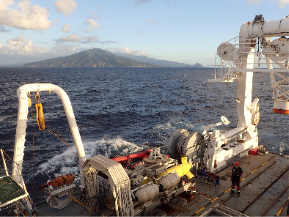
The IFREMER research vessel L’Atalante north of Dominica, SUBSAINTES survey (Henri et al., 2022)
The team studies the evolution of volcanic provinces and edifices in a wide range of geodynamic and climatic contexts, using examples from across the globe (the West Indies, the Azores, Cameroon, the Comoros, Ecuador, Romania, and the major terrestrial magmatic provinces). The approaches employed include K/Ar and 40Ar/39Ar geochronology with very high temporal resolution, quantitative geomorphology, petrology and geochemistry, and modelling. In particular, the rates of construction and dismantling of volcanic edifices are analysed to establish links between deep-seated dynamics (magma genesis, tectonics) and surface processes (climate, weathering, gravitational destabilisation, erosion). Based on this knowledge, we contribute to the assessment of natural hazards and risks, both terrestrial and submarine, in active volcanic regions (the West Indies, Mayotte, Cape Verde, the Azores, the Canary Islands). Global volcanism is also addressed, including the thermal evolution of the primordial magma ocean on terrestrial planets and the modelling of cryovolcanism on Europa.
Rates of formation and erosion of volcanic structures:
Quantitative geomorphology enables us to reconstruct the key stages in the evolution of volcanic structures and to quantify their scale. Volcanoes form and are dismantled over periods that are brief on a geological timescale, and their products can be easily dated. The combination of volumetric and geochronological approaches thus allows us to constrain numerous processes:
I.) Numerically modelling the successive growth surfaces of the structures, quantifying volcanic volumes and construction rates (Hildenbrand et al., 2004; Lahitte et al., 2012; Boulesteix et al., 2012; Germa et al., 2015). These parameters provide strong constraints on the underlying magmatic dynamics in relation to the geodynamic context (Hildenbrand et al., 2004; Boulesteix et al., 2012; Dibacto et al., 2020).
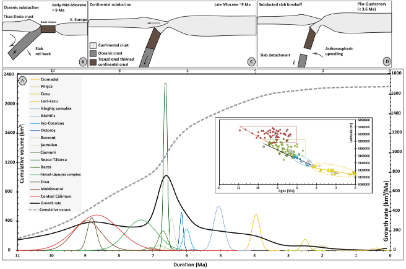
An example of the correlation between eruptive activity and the geodynamic context during the past 10 million years of activity in the Eastern Carpathians (Dibacto et al., 2020).
II) Comparing current volcanic surfaces with pre-erosional surfaces quantifies the volume removed by various processes (massive ‘instantaneous’ collapses, ‘long-term’ erosion following each volcanic phase). Erosion rates integrated over different time periods enable the quantification of erosion dynamics and the linking of their evolution to various parameters, notably spatiotemporal climate variations (Hildenbrand et al., 2008; Salvany et al., 2012; Boulesteix et al., 2013; Costa et al., 2014; Ricci et al., 2015; Dibacto et al., 2020). Recent research (PhD thesis by F. Hevia Cruz) aims more specifically to analyse the effect of Quaternary paleoclimatic variations on the weathering of oceanic volcanoes and the associated landscape evolution.
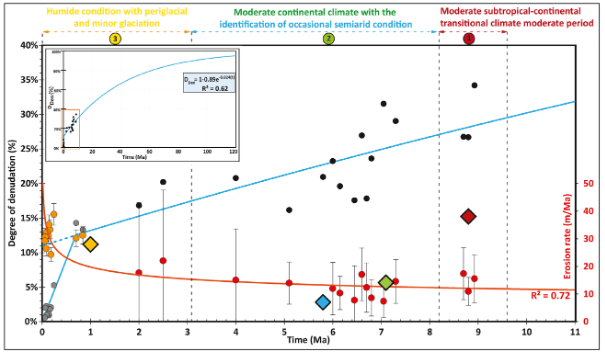
The climatic context of Eastern Europe is shaped by variations in the integrated erosion rates recorded through the erosion of the Carpathian volcanoes (Dibacto et al., 2020).
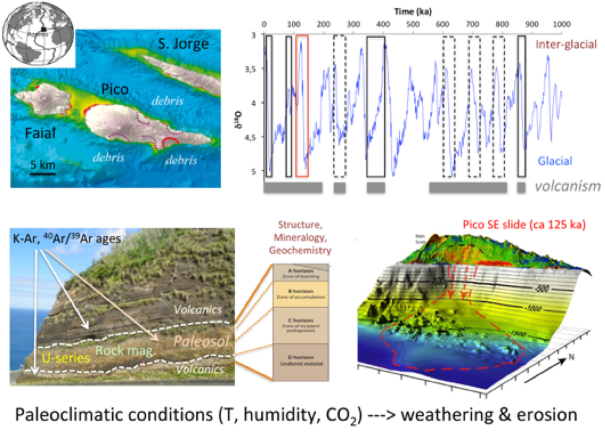
Reconstruction of Quaternary palaeoclimatic conditions through the study of palaeosols in the Central Azores, and analysis of their effects on landscape alteration and degradation (particularly during interglacial periods).
Funding:
CNRS/INSU TELLUS KARVARDAR, participants: P. Lahitte
CNRS/INSU TELLUS CLEAM (2022–2023), participants: A. Hildenbrand, F. Hevia-Cruz
Volcanism and global dynamics
The study of volcanic systems in different geodynamic contexts provides essential constraints on the conditions governing the formation, transport and extraction of magma, and thereby on the dynamics of the Earth.
The study of the relationship between volcanism and tectonics along the eastern branch of the Azores Triple Junction has enabled us to characterise the evolution of the Eurasia–Nubia boundary over the last 6 Ma (Hildenbrand et al., 2008, 2014; Marques et al., 2013; Sibrant et al., 2015a,b, 2016). In a subduction setting, we are studying in Ecuador the relationship between magmatic production and the geometry of the Nazca Plate slab, in particular (Bablon et al., 2019). The team’s projects also focus on volcanism associated with hotspots in Réunion, the Canary Islands, the Azores and Polynesia, as part of research into the deep dynamics of magma genesis.
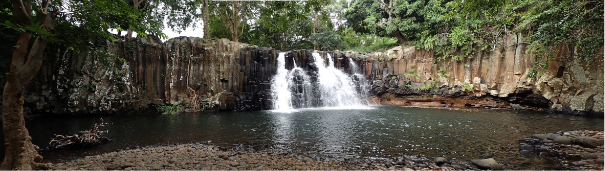
Rockchester Fall, Mauritius
Modelling cryovolcanism on Jupiter’s moon Europa
The low cratering on Europa indicates a very young and active surface, despite its small size. We are studying Europa’s surface and surface-subsurface interactions, in particular the physical modelling of cryovolcanism in the near subsurface. This work will enable us to propose eruption scenarios and test a viscoelastic rheology of the ice in the case of deeper chambers. We hope that the results of this project, combined with recent observations, will contribute to our understanding of eruptive mechanisms on this icy body in relation to the preparation of future missions (e.g. JUICE (JUpiter Icy Moons Explorer) (Grasset, 2013), which will launch in 2022 to the Jovian system to study its icy moons, or Europa Clipper (Howell, 2020). This aspect of the project has resulted in two publications (Lesage et al., 2020 & 2021) and another publication that has just been released (Lesage et al., 2022).