
Funding: CNES, CNRS/INSU
Principal investigators: F. Costard, F. Schmidt
GEOPS staff involved: F. Costard, S. Bouley, A. Séjourné, F. Schmidt, F. Andrieu, A. Hildenbrand, B. Desoubrie, M. Daldoul, L. Martinez
Partners: M. Vincendon (IAS), S. Bourguignon (Ecole Centrale de Nantes), D. Mège and J. Gurgurewicz (Polish Academy of Sciences)
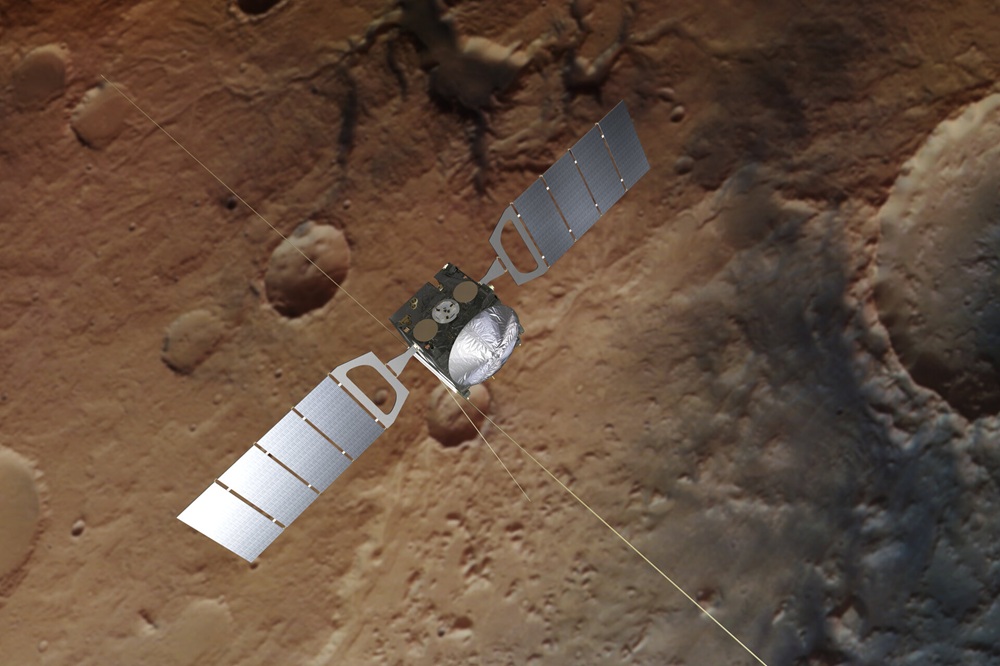
Mars Express is the ESA’s first mission to orbit another planet. Since 2003, it has enabled us to revolutionise our understanding of the Red Planet. Mars Express carries a number of instruments dedicated to studying the surface. Our team is involved in the Mars Express mission: François Costard is Principal Investigator (PI) for the HRSC imager; Frédéric Schmidt is Co-Investigator for the OMEGA hyperspectral imager and the PFS spectrograph.
Regarding the HRSC camera, the aim of this project is to analyse the geomorphological processes on Mars (lobed tsunami deposits in a northern ocean, ancient glaciations of the southern highlands, impact craters) and the possible interactions between these processes through a detailed analysis of the HRSC camera’s images and DTMs. Our team’s key research themes concern (1) the distribution of ice in the permafrost of Mars’s northern highlands, (2) the identification of mega-tsunamis linked to the presence of a late ocean, (3) an analysis of late Hesperian fluvial formations along the Martian dichotomy, and (4) the origin and formation of the Martian Highlands. We employ a multi-disciplinary approach combining photo-interpretation, geological mapping and Artificial Intelligence.
The scientific project led by the GEOPS laboratory to analyse data from the OMEGA and PFS instruments focuses specifically on the study of Martian ice. Indeed, the majority of current active phenomena on Mars are of climatic origin, involving the exchange of water ice or CO₂. The aim of this research programme is the systematic monitoring and modelling of these active phenomena in order to understand their origins and determine their roles in Martian climate history over the last million years. We propose to focus on three dynamic phenomena subject to recent Martian climatic variations through dust and volatile cycles: ‘spiders’, ‘dark flows’, ‘gullies’ and ‘Swiss cheese’. We are developing a radiative transfer model for compacted ice (Andrieu et al., 2015) as the compactness of CO₂ ice is thought to be variable and crucial for a proper understanding of surface-atmosphere interactions on Mars, particularly active flow processes (Andrieu, 2018).
We are developing spectral analysis tools, notably to determine the composition and texture (roughness, grain size, etc.) of Martian surfaces.