

Sedimentary and diagenetic evolution of reservoirs
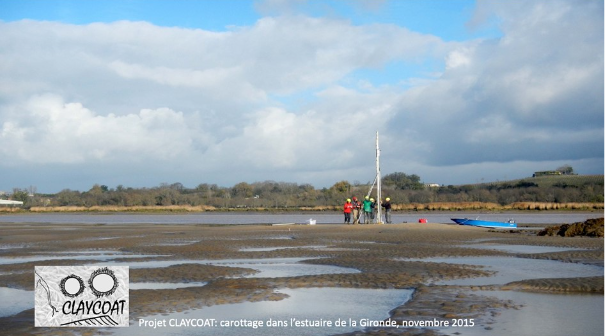
Core sampling in the Gironde estuary
This theme focuses on defining the links between sedimentary rocks (facies, geometry) and diagenetic processes with the aim of proposing conceptual models for predicting reservoir qualities (water, hydrocarbons, rare gases, natural hydrogen, CO2 storage). Combining diagenesis with sequential stratigraphy models is essential in order to better predict the preferred locations for sediment hardening and the heterogeneity of reservoir qualities on a carbonate (marine and continental) or detrital platform. In particular, we address the characterization, origin, and spatio-temporal prediction of the chloritization process in sandstones, one of the major processes controlling reservoir quality. The approach adopted is to compare deep reservoirs (>2500 m), rich in chlorite, with current analogues or moderately buried reservoirs (400-1000 m) by linking sedimentary architecture and diagenetic processes. Furthermore, being able to date and estimate the duration of diagenetic processes is key to understanding the evolution of sediments in a basin and their reservoir quality. We develop and apply U-Pb dating on carbonates using laser ablation techniques coupled with mass spectrometry in order to understand the paleo-circulation of fluids responsible for the clogging or dissolution of limestones.
Permanent/Non-permanent list:
Cédric Bailly, Jocelyn Barbarand, Thomas Blaise, Benjamin Brigaud, Sarah Figowy, Julius Nouet, Gaël Monvoisin, Amélie Plautre, Charlie Marconnet, Tarik Kernif, Hélène Cassagne