

Geology of resources for energy transition: applications to metals (Li, etc.), gases (He and H2), and geothermal energy
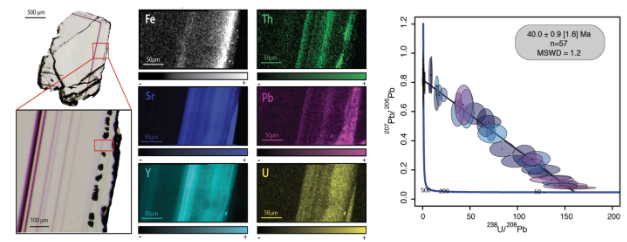
U-Pb dating of a fluorite crystal from Pierre Perthuis (Morvan, France)
The goal of reducing greenhouse gases requires developing energy sources that emit less CO2, such as geothermal energy, and securing the supply of raw materials needed for electric car batteries (Li, Mn, Ni, Co), nuclear energy (U), and the automotive and semiconductor industries (place of F to ensure the chemical separation processes of minerals). Identifying geological risks that are unfavorable to the discovery of new deposits requires the implementation of new models. Our team is working on innovative characterization and modeling methods, proposing solutions that optimize and explore the development of new resource areas. This optimization requires precise knowledge of the heterogeneity of the subsurface in terms of sedimentary geometries, porosity/permeability, connectivity of sedimentary bodies or permeable/mineralized fractures, reliable numerical simulations of flows or heat flows, and the availability of chemical elements (lithium, He, or H2) in geothermal deposits. Methodologies for improving understanding of the scale jump between spot analyses in the laboratory and their representation at the reservoir and basin scales are at the heart of this theme.
Permanent/Non-permanent list:
Cédric Bailly, Antonio Benedicto, Thomas Blaise, Benjamin Brigaud, Marine Collignon, Emmanuel Léger, Sarah Figowy, Beate Orberger, Carlos Pallares, Pascal Sailhac, Bertrand Saint-Bézar, Philippe Sarda, Hermann Zeyen, Jean-David Moreau, Frédéric Haurine, Gabriel Zacharias, Andrès Mejia, Paul Coutable, Heming Wang, Théo Rubio, Hugo Pierrot, Guillaume Gallien