

Geodynamic control on the evolution of intraplate domains
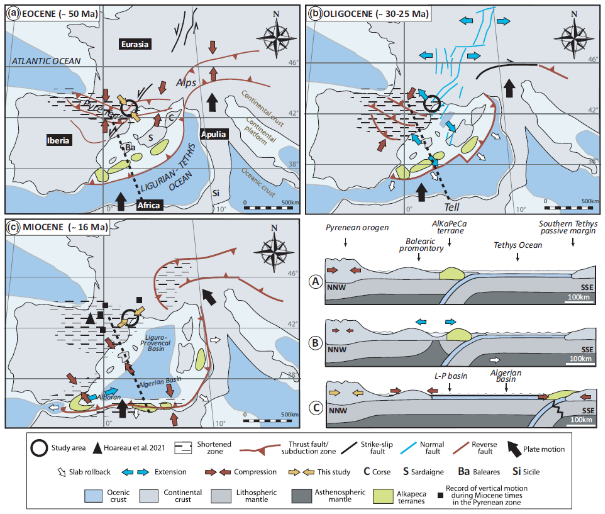
Geodynamic evolution of the western Mediterranean during the Cenozoic (Parizot et al. 2021)
Intraplate deformations, although an order of magnitude less intense than those at plate boundaries, nevertheless exert a major control over the geological functioning of entire domains, particularly with regard to “s.l.” fluid circulation. These deformations manifest themselves at long wavelengths through vertical movements (exhumation or subsidence) that can extend over several kilometers, and at shorter wavelengths through the reactivation of basement faults, the neoformation of tectonic features in the sedimentary cover, or fold deformation. The objectives of this research area are (1) to characterize these deformations, (2) to date them, (3) to establish the link with deformations at plate boundaries in a global geodynamic framework, and (4) to highlight the relationships between these deformations and episodes of fluid circulation and associated mineralization. The main sites targeted are the eastern Paris Basin, the Aquitaine Basin (Quercy), the Pyrenees, North Africa, and Canada. They are approached using conventional sedimentological and tectonic methods, as well as geochemical and geochronological methods (low-temperature thermochronology and U-Pb dating on various mineral phases).
Permanent/Non-permanent list:
Jocelyn Barbarand, Benjamin Brigaud, Thomas Blaise, Yves Missenard, Carlos Pallares, Agathe Jullien-Sicre, Hugo Pierrot