

Assessing the potential and monitoring the performance of small-scale geothermal systems (0-200m) under Greater Paris area (THERMOPARIS)
The task « Assessing the potential and monitoring the performance of small-scale geothermal systems (0-200m) under Greater Paris area (THERMOPARIS) » is one of the fourteen tasks of the targeted project n°10 (PC10) « S-PASS: Paris Basin – The resources and uses of the urban subsurface » https://www.soussol-bien-commun.fr/en/s-pass-paris-basin-resources-and-uses-urban-subsurface, part of the « Sous-sol » Priority Research and Equipment Program (PEPR), funded by France 2030. Coordinated by the University of Paris-Saclay, this project also brings together researchers from BRGM and the University of Strasbourg.
There is growing interest in the geothermal resources available at shallow depths beneath cities (<200 m), known under French law as ‘géothermie de minime importance’. Indeed, the potential beneath Greater Paris area has recently been assessed as enormous by BRGM (Maragna et al., 2022). Ile-de-France Region is already the region in the world with the highest concentration of heat production units extracted by deep geothermal energy (essentially Dogger), but this resource is suited to large distribution networks for collective housing, not suitable for much less dense, more recent neighbourhoods or areas, which concerns many buildings. The development of surface geothermal energy, which in addition to extracting heat, can also provide cooling (geocooling), is therefore a crucial issue recently highlighted by the Haut-Commissariat au Plan (Bayrou, 2022). This development seems essential if urban areas are to achieve carbon neutrality in terms of heating and cooling buildings.
There are two main types of system for extracting heat: (1) open-loop systems using groundwater (generally doublet) and (2) closed-loop systems, mainly vertical geothermal probes (in aquifers or non-aquifers). The problem of which type of installation to use arises in many cities, and work has been carried out to quantify the potential of surface geothermal energy. This work is based on the development and calibration of numerical hydrogeological and thermal models (often using Feflow software), for example in Zaragoza (García-Gil et al., 2015), Lyon (Attard, Rossier and Eisenlohr, 2016, 2017; Attard, Rossier, et al, 2016; Attard, Winiarski, et al., 2016), Basel (Mueller, Huggenberger and Epting, 2018), or Turin with a particular focus on anthropogenic underground structures (metro tunnels, etc.) (Barla, Di Donna and Perino, 2016; Barla and Insana, 2023). Attempts have been made to extrapolate these numerical results from the neighbourhood scale to the metropolitan scale (Epting et al., 2017, 2018, 2020). However, there is no real procedure for assessing the sustainability of the extraction of a given area, neighbourhood or housing block. The project’s scientific question is: what exploitation rate (number of geothermal systems) can we set up in a given area under Greater Paris?
The experience gained in extracting heat from deep geothermal systems can be reproduced with open-loop systems by coupling sedimentology, petrophysics, diagenetic alteration and thermo-hydro-dynamic modelling, where the effects of interaction between doublets can be taken into account. Numerous proven codes (TOUGH3, ECLISPE, MARTHE, COMPASS, FEFLOW, etc.) exist (1) to predict heat extraction under high stress (with many doublets) and (2) to predict their durability in this type of open system (per doublet). On the other hand, much less work has been done on surface geothermal energy in the Greater Paris region, which makes it difficult to predict the thermal evolution of the environment and the energy available for housing over several decades (see more), by taking into account (1) the interaction between different operating systems (open and closed), (2) or different structures in different levels, (3) the use of technical performance standards or (4) competition between systems and (5) assessing a conflicting use of geothermal energy on other uses of the subsurface.
In order to meet these needs, the two main objectives of the task will be to provide:
- A methodology for modelling the geothermal potential (and usable in a sustainable manner) of minor importance at the scale of a district in the Greater Paris area, down to a depth of 200 m, and/or including the chalk, and assessing its temporal evolution.
- New geophysical sensors that are minimally invasive, permanent and adapted to the underground environments of Greater Paris, making it possible to observe changes in the thermal regime of the subsurface in the vicinity of geothermal structures over the long term (10-20 years).
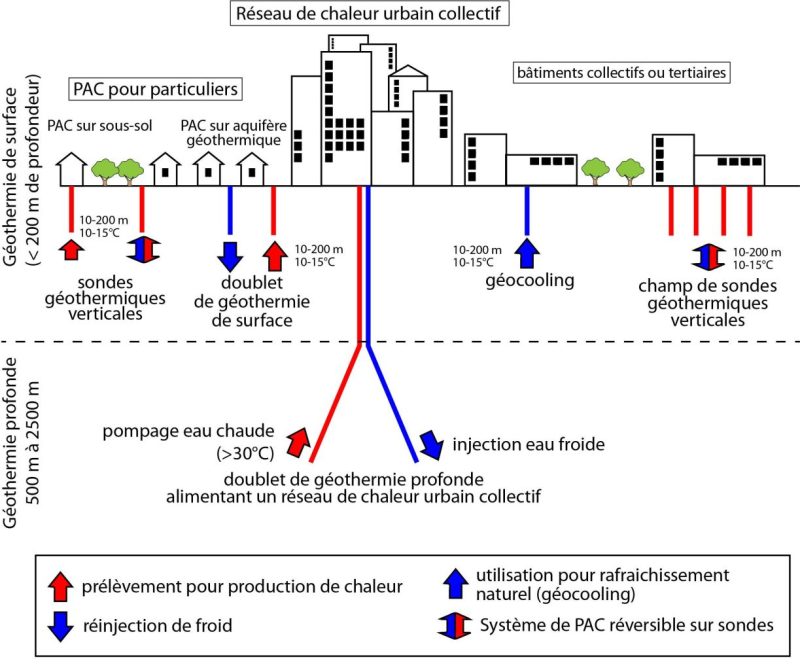
Example of the use of heat or cooling in an urban environment. With deep geothermal energy, the heat is exploited by a doublet, supplying a collective urban heating network. With surface geothermal energy, a heat pump (PAC) harnesses the energy of the subsurface with probes or doublets on the water table to heat buildings in winter. The heat pump can be reversible, used in air-conditioning mode in summer, or used as a standby system. If there is no heat pump, the probes can be used to cool the buildings by geocooling. Benjamin Brigaud, Provided by the author
References
Attard, G., Rossier, Y., et al., 2016. Deterministic modeling of the impact of underground structures on urban groundwater temperature’, Science of the Total Environment, 572, pp. 986–994. https://doi.org/10.1016/j.scitotenv.2016.07.229
Attard, G., Winiarski, T., et al., 2016. Revue: Impact des structures du sous-sol sur les écoulements des eaux souterraines en milieu urbain’, Hydrogeology Journal, 24(1), pp. 5–19. https://doi.org/10.1007/s10040-015-1317-3
Attard, G., Rossier, Y. and Eisenlohr, L., 2016. Urban groundwater age modeling under unconfined condition – Impact of underground structures on groundwater age: Evidence of a piston effect’, Journal of Hydrology, 535, pp. 652–661. https://doi.org/10.1016/j.jhydrol.2016.02.034
Attard, G., Rossier, Y. and Eisenlohr, L., 2017. Underground structures increasing the intrinsic vulnerability of urban groundwater: Sensitivity analysis and development of an empirical law based on a groundwater age modelling approach’, Journal of Hydrology, 552, pp. 460–473. https://doi.org/10.1016/j.jhydrol.2017.07.013
Barla, M., Di Donna, A. and Perino, A., 2016. Application of energy tunnels to an urban environment’, Geothermics, 61, pp. 104–113. https://doi.org/10.1016/j.geothermics.2016.01.014
Barla, M. and Insana, A., 2023. Energy tunnels as an opportunity for sustainable development of urban areas’, Tunnelling and Underground Space Technology, 132, p. 104902.: https://doi.org/10.1016/j.tust.2022.104902.
Bayrou, F., 2022. la géothermie de surface : une arme puissante (No. Ouverture N° 12). Haut‐Commissariat au Plan.
Epting, J. et al., 2017. Development of concepts for the management of thermal resources in urban areas – Assessment of transferability from the Basel (Switzerland) and Zaragoza (Spain) case studies’, Journal of Hydrology, 548, pp. 697–715. https://doi.org/10.1016/j.jhydrol.2017.03.057
Brigaud, B., 2023. La géothermie, enjeu majeur pour la neutralité carbone des zones urbaines, The Conversation https://theconversation.com/la-geothermie-enjeu-majeur-pour-la-neutralite-carbone-des-zones-urbaines-207994
Epting, J. et al., 2018. Relating groundwater heat-potential to city-scale heat-demand: A theoretical consideration for urban groundwater resource management’, Applied Energy, 228(June), pp. 1499–1505. https://doi.org/10.1016/j.apenergy.2018.06.154
Epting, J. et al., 2020. City-scale solutions for the energy use of shallow urban subsurface resources – Bridging the gap between theoretical and technical potentials’, Renewable Energy, 147, 751-763 https://doi.org/10.1016/j.renene.2019.09.021
García-Gil, A. et al., 2015. Recovery of energetically overexploited urban aquifers using surface water’, Journal of Hydrology, 531, pp. 602–611. https://doi.org/10.1016/j.jhydrol.2015.10.067.
Maragna, C., Les Landes Antoine, A., Durst, P., Dupaigne, T., 2022. Cartographie du potentiel de la géothermie de surface sur le territoire de la Métropole du Grand Paris (Rapport final V2 No. BRGM/RP-71139-FR). https://infoterre.brgm.fr/rapports//RP-71139-FR.pdf
Mueller, M.H., Huggenberger, P. and Epting, J., 2018. Combining monitoring and modelling tools as a basis for city-scale concepts for a sustainable thermal management of urban groundwater resources’, Science of the Total Environment, 627, pp. 1121–1136. https://doi.org/10.1016/j.scitotenv.2018.01.250
Project leaders : Benjamin Brigaud and Frédéric Dubois (BRGM)
Funding : Targeted project n°10 (PC10) S-PASS: Paris Basin – The resources and uses of the urban subsurface » https://www.soussol-bien-commun.fr/en/s-pass-paris-basin-resources-and-uses-urban-subsurface, « Sous-sol » Priority Research and Equipment Program (PEPR), funded by France 2030
Staff involved at GEOPS
Benjamin Brigaud, Pascal Sailhac, Marc Pessel, Cédric Bailly, Emmanuel Léger, Hermann Zeyen
Collaboration with
BRGM, Cergy Paris Université et Université de Strasbourg (ITES/EOST)