

Prediction of Reservoir Heterogeneities for the Characterisation of GeoThermal Resources (PR3DICT)
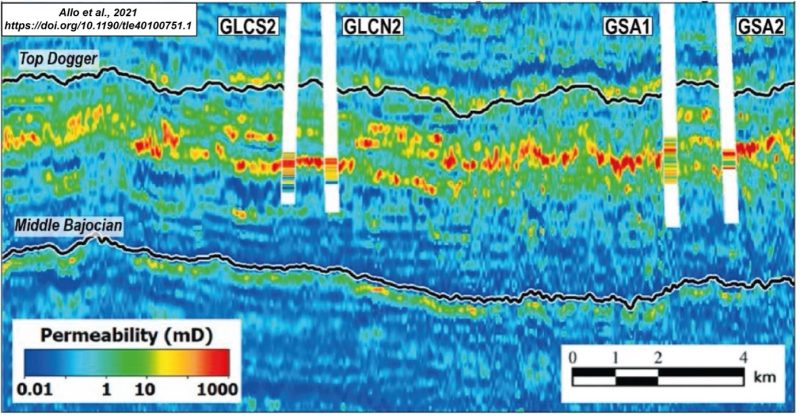
The lack of well data, including core analysis, or recent seismic surveys from the surface, is often an obstacle to the accurate assessment of geothermal reservoir properties, such as porosity, permeability, productivity and injectivity. The data available for deep geothermal energy is usually incomplete (very few cores and few logs deployed) and not very dense. As a result, very little 3D data is available, enabling the subsurface to be imaged and characterised at high resolution. To reduce the geological hazard, it is therefore necessary to better predict the properties of geothermal reservoirs in space, based on sparse or incomplete data. The PR3DICT « Prediction of Reservoir Heterogeneities for the Characterisation of GeoThermal Resources » project aims to meet this need by proposing a methodology based on oil exploration techniques to predict the spatial heterogeneity of the properties of porous and permeable bodies in geothermal reservoirs, with a case study of the Dogger in the Paris Basin where the data is mainly 1D (wells) or 2D (seismic). The PR3DICT project is coordinated by BRGM and includes the Université Paris-Saclay and SLB. It is funded by ADEME. As part of this project, SLB will carry out petrophysical modelling and quantitative seismic imaging on a 3D seismic cube around Melun in an area that has been extensively studied for hydrocarbon exploitation. BRGM will be responsible for analysing and predicting the 3D heterogeneities of the Dogger in the same area. The study entrusted to the University of Paris-Saclay (GEOPS) will focus on the development of a static and dynamic modelling workflow applied to a sector where there is a large amount of production data from geothermal boreholes and where old 2D seismic data is present with a density representative of geothermal resource exploration or exploitation sectors in France, but where there is no recent seismic data (no 3D block, for example). We therefore chose to work on an area located on the north-eastern outskirts of Paris (Seine-Saint-Denis and Val-de-Marne departments). This area was studied in detail as part of the MINERGIES projects led by BRGM in 2020 and ANR UPGEO (2020-2025). The study, entrusted to the University of Paris-Saclay (GEOPS), is organised into 3 main tasks (1) development of static geological models (structural, stratigraphic, facies and rock type), (2) construction of different static porosity and permeability models based on a multi-scale approach to the petrophysical properties of the reservoir and (3) dynamic simulation and validation of predictive power. The aim of the project is to validate a methodology for characterising the reservoir using old seismic and well data, without the need for new exploration. This will optimise the use of the large amount of existing data and limit the costs of a future exploration phase.
Project leader : Cédric Bailly
Funding : ADEME, Appel d’offre ADEME, contrat 2023-3397
Staff involved at GEOPS : Cédric Bailly, Benjamin Brigaud and Heming Wang
Collaboration with : BRGM et SLB