

Assessment of the Natural Hydrogen Potential in the Île-de-France (IDF) Region
Scientific and Technical Objectives. The observation of natural hydrogen indicators in the Paris Basin (Lefeuvre et al., 2024) raises the question of possible natural hydrogen accumulations in the subsurface of the Île-de-France (IDF) region. To assess this emerging resource, the H2-IDF project will investigate the potential sources of this gas, its migration pathways, and its modes of accumulation. To achieve this goal, existing datasets (drilling records, geophysical data) will be integrated, together with data obtained from ongoing geothermal projects. In addition, targeted light geochemical and geophysical field acquisitions will be carried out. This integrated, multi-scale and multi-physics approach will enable the identification of sites potentially favorable for industrial exploration.
Innovative Nature. To date, no comprehensive study of the hydrogen system in the Paris Basin has been conducted, except for an internal study carried out by CVA that led to the publication cited above (Lefeuvre et al., 2024), which identified hydrogen indicators in legacy wells. The H2-IDF project will therefore be the first to investigate the origin of natural hydrogen in the Île-de-France region, its migration pathways, and its potential accumulations. The project will also contribute to the development of methods and tools specifically adapted to the characteristics of natural hydrogen, enabling more reliable detection of surface indicators than existing tools, which were developed for other applications and are not fully suited to natural hydrogen exploration.
Techno-Economic Objectives. If the H2-IDF project is successful, the first industrial milestone envisioned for 2028 will be the submission of an application to the French Directorate General for Energy and Climate (DGEC) for an Exclusive Exploration Permit (Permis Exclusif de Recherche – PER). This PER would provide the regulatory framework necessary to conduct subsurface investigations (geophysical surveys and drilling) aimed at confirming and quantifying the resource. The H2-IDF project is positioned upstream of this PER application, and its primary goal is to deliver the technical and economic elements required to encourage investors and operators to commit to such a venture. The technical objectives are therefore to validate the hypothesis of an active hydrogen system in IDF and, in particular, to identify geological structures favorable to natural hydrogen accumulation. Based on these technical results, economic modeling will be performed. A key economic factor for the project is drilling cost, which is directly correlated with drilling depth. By the end of the H2-IDF project, it will therefore be necessary to estimate the depth of potential targets in order to assess drilling capital expenditures (CAPEX).
Territorial Objectives. The production of white (natural) hydrogen in the Île-de-France region could contribute significantly to decarbonizing the hydrogen sector by reducing greenhouse gas emissions. Natural hydrogen production is low-energy, carbon-free, and does not rely on critical or rare minerals/metals. Moreover, natural hydrogen generation does not consume potable groundwater resources and does not require human intervention, either in terms of energy input or water supply. Producing white hydrogen in IDF would also help preserve fossil resources. According to current knowledge, natural hydrogen is generated at a constant flux, making its production continuous on human timescales. It is therefore not a finite stock.
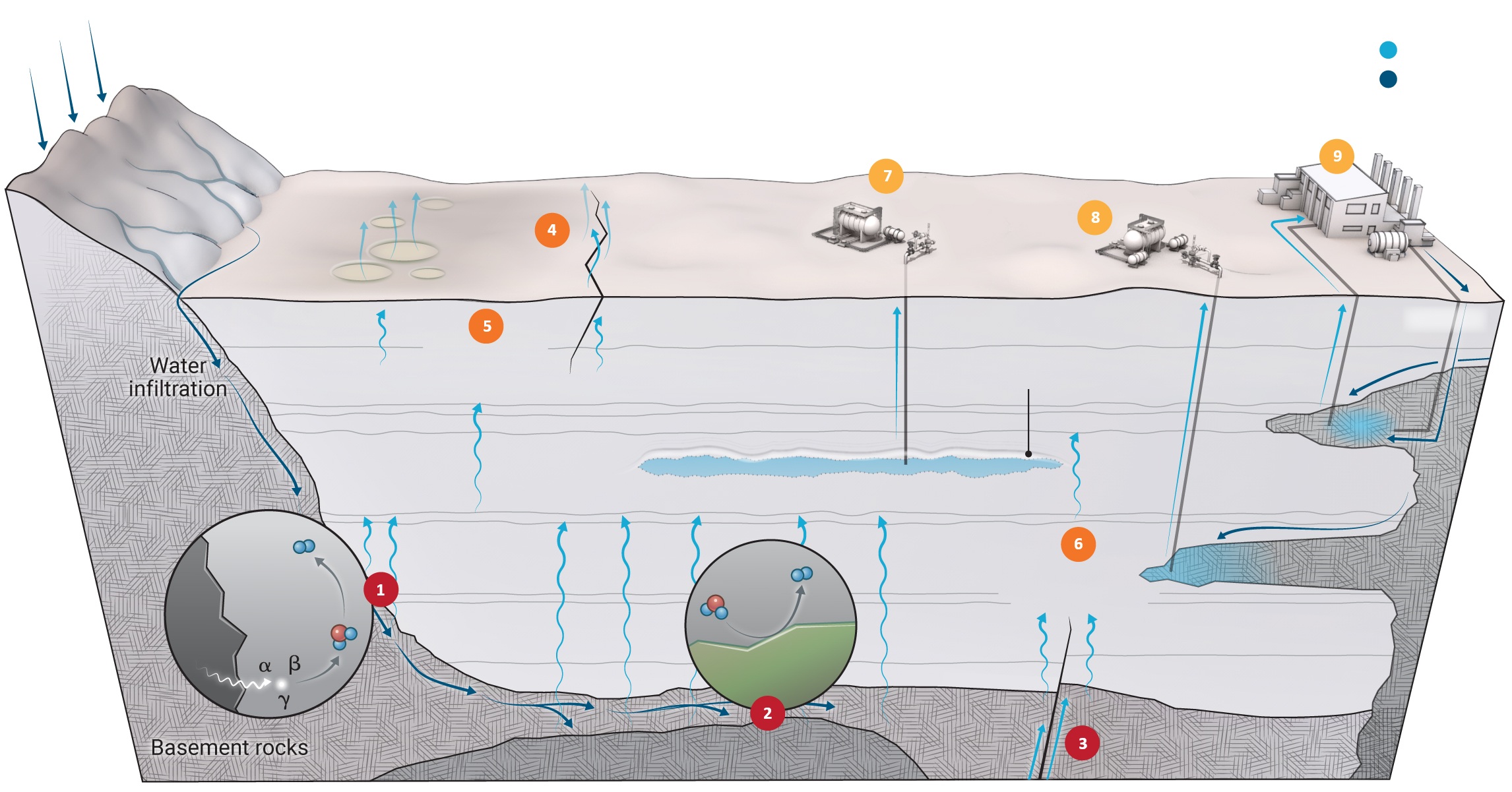
“Hydrogen Kitchen” : Generation mechanisms: (1) radiolysis, (2) serpentinization, (3) deep-seated processes; Loss mechanisms: (4) seeps, (5) microbial consumption, (6) abiotic reactions; Extraction modes: (7) trapped, (8) direct, (9) enhanced.
Source: Eric Hand (2023), Science.
https://www.science.org/content/article/hidden-hydrogen-earth-may-hold-vast-stores-renewable-carbon-free-fuel
Reference
Lefeuvre, N., Thomas, E., Truche, L., Donzé, F., Cros, T., Dupuy, J., Pinzon-Rincon, L., Rigollet, C. (2024). Characterizing Natural Hydrogen Occurrences in the Paris Basin From Historical Drilling Records. Geochemistry, Geophysics, Geosystems, 25, e2024GC011501. https://doi.org/10.1029/2024GC011501
Project Leaders : Christophe Rigollet (CVA) and Benjamin Brigaud (Université Paris-Saclay)
Funding Sources : Île-de-France Region and Bpifrance
GEOPS staff Involved : Gabriel Zacharias, Benjamin Brigaud, Emmanuel Léger, Philippe Sarda, Hermann Zeyen
Collaborations
CVA : Christophe Rigollet, Keanu Loiseau
CVA is a service company founded in the Île-de-France region in 2006 and currently employs approximately 500 people (www.group-cva.com). It provides clients with solutions for the assessment and exploitation of subsurface resources (natural hydrogen, geothermal energy, geological energy storage, geological CO₂ storage, etc.). CVA is headquartered in Rueil-Malmaison, with additional offices in Pau and Bayonne, and serves around one hundred clients in some forty countries, although the majority of its revenue is generated in France. CVA offers the full value chain of expertise, including geological data acquisition (geochemical campaigns, drilling, etc.), geophysical data acquisition (magnetics, gravimetry, gamma spectrometry, seismic surveys, etc.), data processing and management, interpretation, as well as static and dynamic modeling for subsurface resource evaluation and exploitation.
GEOLINKS SERVICES : Frédéric Moinet, Jean-Charles Ferran, Thomas Kremer
GEOLINKS SERVICES is a start-up dedicated to geophysical solutions for subsurface resource exploration and exploitation (https://geolinks-services.com). Founded in 2021, it is based in Massy (Essonne, France). GEOLINKS is transforming subsurface monitoring through the development of an innovative and cost-effective underground geophysical monitoring solution that goes well beyond existing options. This passive seismic system enables safe and sustainable use of the subsurface for the mining industry, as well as for natural hydrogen and underground gas and CO₂ storage applications.