

Context. The task « Spatial variability and characterisation of Cenozoic carbonate, clay and evaporite facies at high resolution in the Greater Paris area » is one of the fourteen tasks of « targeted project n°10 » (PC10) « S-PASS: Paris Basin – The resources and uses of the urban subsurface » https://www.soussol-bien-commun.fr/en/s-pass-paris-basin-resources-and-uses-urban-subsurface, part of the « Sous-sol » Priority Research and Equipment Program (PEPR), funded by France 2030. Coordinated by the Université Paris-Saclay, this project also brings together researchers from ISTEP/Sorbonne Université, Biogéosciences/Université de Bourgogne, Institut de Physique du Globe de Paris (IPGP)/Université Paris-Cité, Environnements et Paléoenvironnements Océaniques et Continentaux (Epoc)/Université de Bordeaux-Bordeaux INP, Université de Lyon 1 and BRGM. In particular, the PEPR programme funds Thomas Munier’s post-doctoral salary for a period of two years, starting in April 2025.
Problematic of the task. Understanding the physico-chemical properties responsible for the in situ precipitation of carbonates and sulphates, as well as quantifying the production, export and transport of carbonates – sulphates (palaeo-circulations and recent circulations) and terrigenous products (clays, sands), are fundamental processes whose proper understanding should enable better modelling of facies variability in time and space. This high-resolution modelling will be one of the stated aims of the S-PASS project, a decision-making tool for better identification, exploitation and management of the Greater Paris subsurface resources. Understanding sedimentary architectures and petrophysical properties in a mixed clastic (clay levels), carbonate and sulphate system is a fundamental challenge that must take into account sedimentary sources, the nature of transport, sedimentary flows and diagenesis. The respective global (marine incursions, tectonics or climate) and local (nature of particles/sediments, karstification, in-situ carbonate productivity, terrigenous inputs, trophic conditions, topography, impact of biological communities and more particularly microbial communities) roles on the sedimentary dynamics of production, export and transport of the mixed carbonate/evaporite system remain to be investigated in order to determine the dynamics and their respective roles. The impact of these processes on the nature of the depositional environments and their heterogeneity remains to be defined, particularly in terms of the possible ‘mosaic’ arrangement of facies on the platform.
In addition, numerous clay layers are present in the subsurface of the Greater Paris area. Local silicification processes (in carbonates, sands or evaporites) may develop. These deposits are all the more problematic in that they may contain swelling clays and/or pyrite, which are unstable during oxidation processes (excavation, tunnelling, development). The diagenetic processes of silicification, which are difficult to predict, pose problems during the advance of tunnel boring machines. A detailed understanding of the architecture and nature of these clay units, as well as evaporitic or carbonate deposits with a high potential for transformation, is therefore essential to better predict heterogeneities, lateral variations and differences in behaviour in the context of the Greater Paris urban development project.
Methodology. In this project we propose to describe and sample cores available from the Société du Grand Paris (SGP) and the RATP in order to identify the diversity of facies within a well constrained geometric, palaeoenvironmental and stratigraphic framework, also incorporating logging data (GR, resistivity, sonic, etc.). New temporal constraints via biostratigraphic and/or geochronological analyses (U-Pb; Sr isotopes) of carbonates and more particularly microbial carbonates will be carried out in order to specify the ages within certain formations. Geochemical analyses of carbonates and evaporites, analyses of the clay fraction and analyses of organic matter will be carried out in order to distinguish the origin and potential sources of Cenozoic sediments in a continent-ocean continuum. The spatial distribution of facies heterogeneities and the associated early diagenesis are strongly influenced by the marine or continental depositional environments.
These core descriptions will be supplemented by work on underground quarries (on the scale of an urban block/neighbourhood) using 3D photogrammetry in order to spatialise facies heterogeneities, chemical or mineralogical variability and key surfaces, on a scale representative of an urban subsurface (XYZ: 1 km x 1 km x 50 m). The final objective will be to spatialise facies heterogeneities and monitor key surfaces on the scale of one or more urban districts. The size of the study area will depend on the core samples available to the SGP or the underground quarries that can be visited, in conjunction with the Inspection Générale des Carrières (IGC). This new data on carbonate, sulphate and clay formations will provide a relevant grid in terms of the variability of sedimentary deposits and the diagenetic overprinting affecting them in the Ile-de-France area, which is essential for producing a high-resolution 3D geological model and the geotechnical model that depends on it.
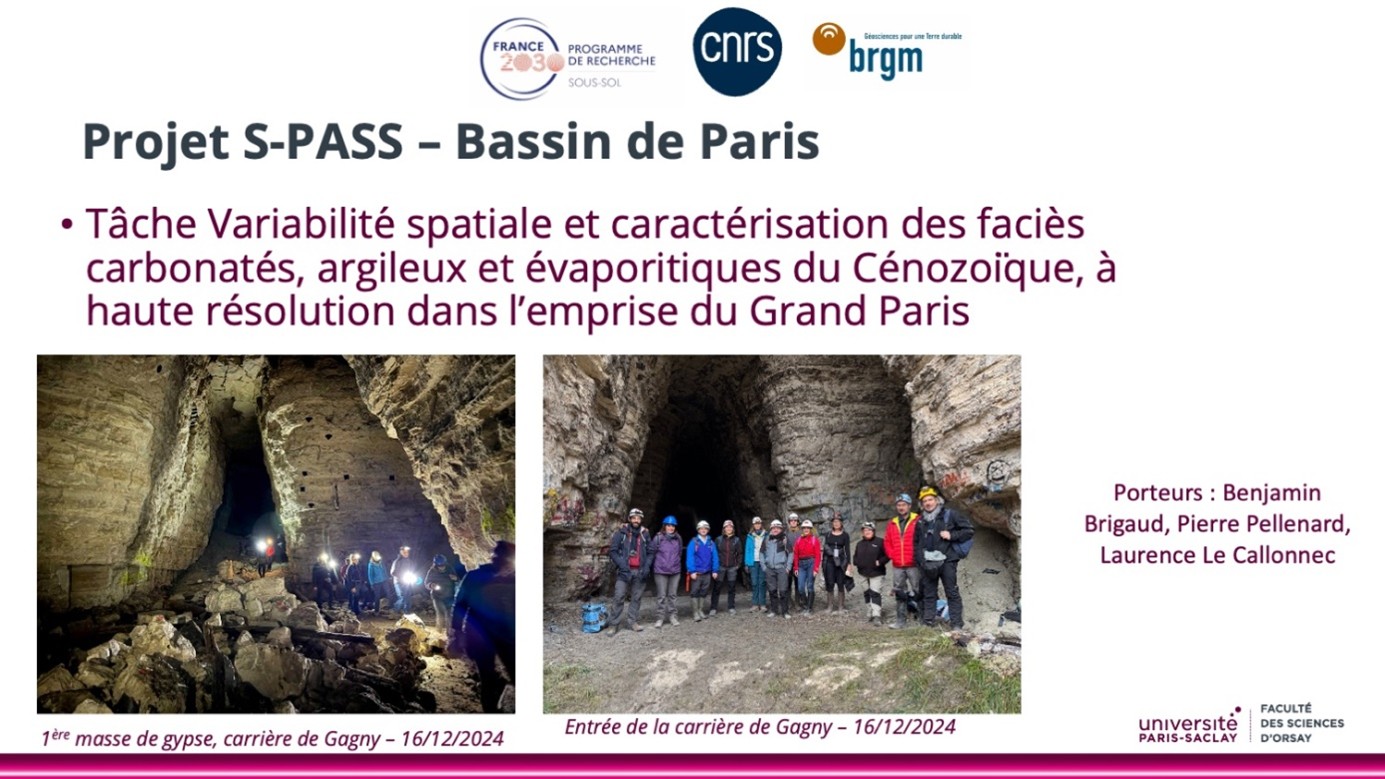
Etude des carrières souterraines
Project leaders : Benjamin Brigaud (Géosciences Paris-Saclay), Pierre Pellenard (Biogéosciences), Laurence Le Callonnec (ISTEP)
Funding : Targeted project n°10 (PC10) S-PASS: Paris Basin – The resources and uses of the urban subsurface » https://www.soussol-bien-commun.fr/en/s-pass-paris-basin-resources-and-uses-urban-subsurface, « Sous-sol » Priority Research and Equipment Program (PEPR), funded by France 2030
Staff involved at GEOPS : Benjamin Brigaud, Cédric Bailly, Gaël Monvoisin, Jean-David Moreau, Thomas Munier, Charlie Marconnet, stagiaire M2
Collaboration with : Université Bourgogne Europe, Sorbonne Université, Université Paris Cité, Université de Bordeaux, Université de Lyon 1, et BRGM